
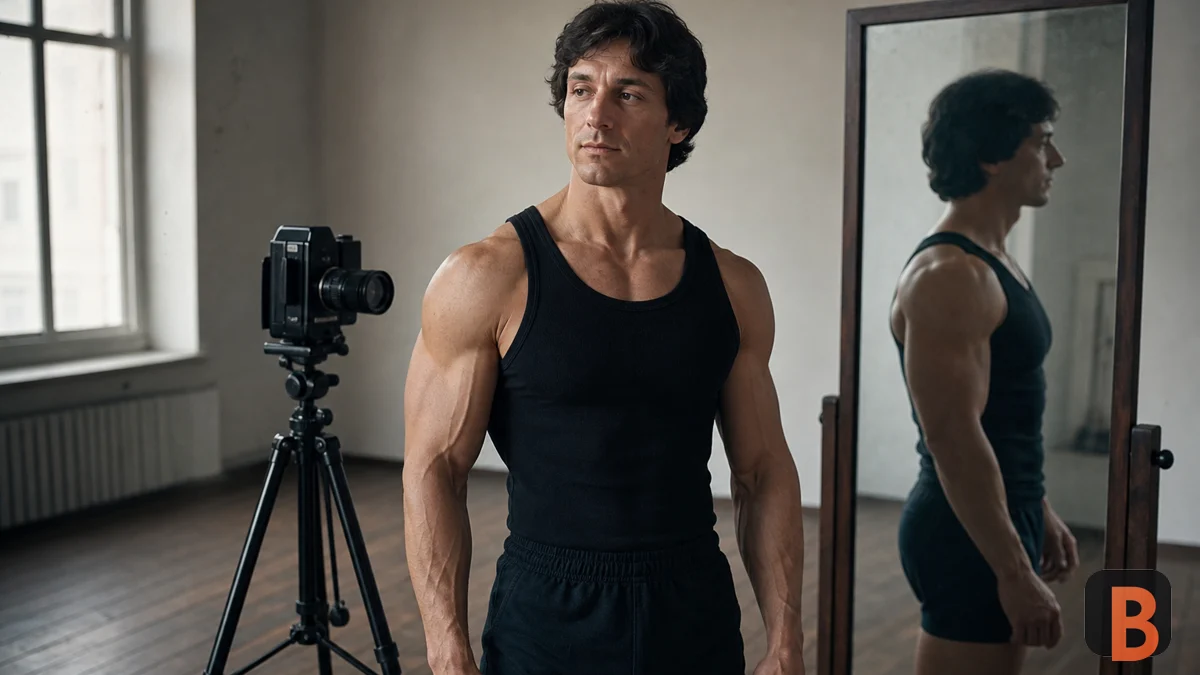
A camera that did not know how to flatter
Frank and Christine Zane formed one of bodybuilding's most interesting visual partnerships. She brought artistic training and photography; he brought a physique he wanted to examine precisely. The images were more than memory or promotion. They revealed lines, vacuums, angles and imbalances a mirror could soften.
That practice explains much about Zane. Preparation did not finish when the final dumbbell was set down. It continued through posing, breathing, reviewing an image and choosing what deserved attention. The body was physical work and a problem of perception.
From mathematics teacher to three-time Olympia
| Year | Moment | Why it matters |
|---|---|---|
| 1968 | Wins Mr. America and beats Arnold at Mr. Universe | He joins the elite without relying on being the largest. |
| 1977 | First Mr. Olympia | His combination of proportion and condition reaches the professional summit. |
| 1978 | Second consecutive title | The result proves repeatable. |
| 1979 | Third Olympia | Zane regarded this win as his best competitive expression. |
Away from the stage, he studied education and psychology, taught mathematics and wrote for decades about training and the mind. The mixture suits his style: observe, formulate, test, keep what works and observe again.
Aesthetic never meant small
Modern comparisons often oppose mass and aesthetics as though Zane were a slight athlete winning through elegance alone. He was an extremely muscular, highly conditioned bodybuilder. What made him unusual was that size never erased the organization of the whole.
| Tool | What it provided | Myth to release |
|---|---|---|
| Abdominal vacuum | Drew the torso and strengthened the visual waist | It cannot magically change another person's anatomy. |
| Posing transitions | Kept the physique readable between poses | They were not decoration. |
| Frequent photography | Turned perception into an outside reference | One photograph does not measure muscle mass. |
| Attention to symmetry | Prevented one area from swallowing the whole | Symmetry is not one formula for everyone. |
The Zane lesson: measure, present, repeat
- Keep a reference
Use photographs with similar posture, distance and light rather than each week's best angle.
- Read the whole
Ask which area dominates, which line disappears and which improvement is already visible.
- Connect image and training
Observation only matters when it leads to a specific, testable decision.
- Practise presentation
Posing reveals control, endurance and blind spots that casual standing hides.
A Zane-style review
The shoulder has improved, yet the torso loses width when the arm rises. Do not change six exercises. Practise the pose, decide whether presentation is the issue and alter training only if the trend supports it.
At BUSTAFIT, we admire that patience. Zane did not turn detail into noise; he used it to decide. The app takes a similar approach to training by keeping load, repetitions, RIR and history so the next choice does not rest on a passing impression. Aesthetics remain personal; the reference can be clear.