
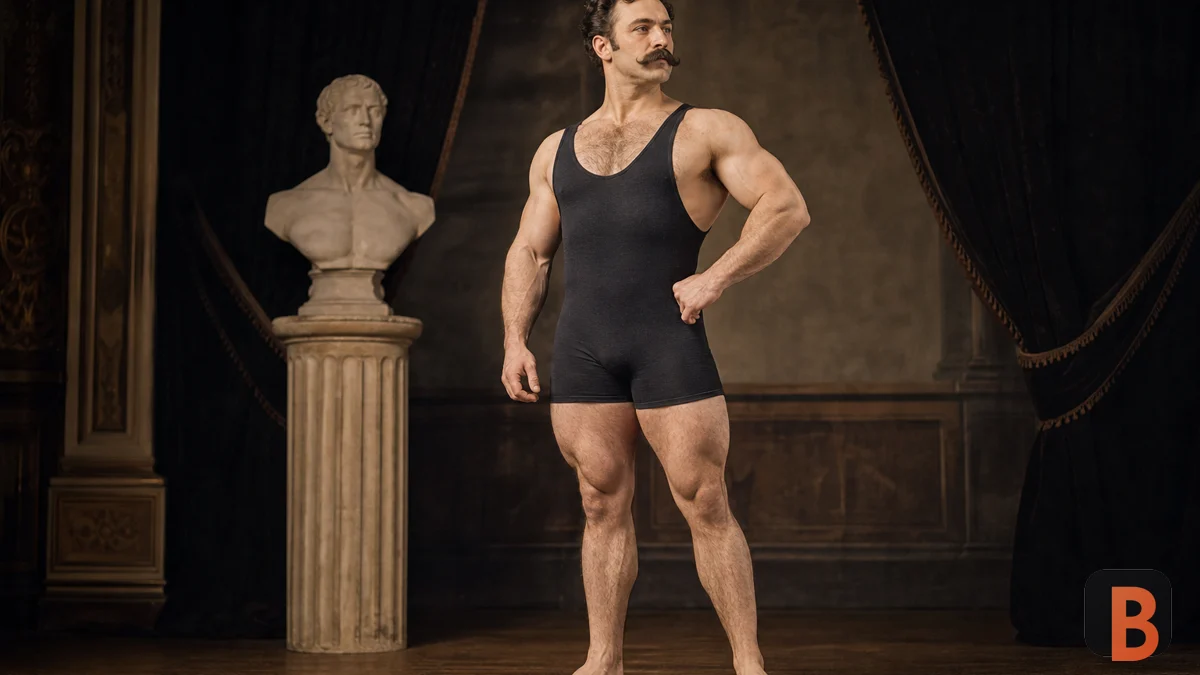
The day a music-hall body entered a museum
In 1901, while much of Victorian society still treated muscular display as fairground entertainment, naturalist Ray Lankester wanted Sandow's body preserved like a classical sculpture. Making the cast took repeated sessions. Sandow had to stand rigid, keep his muscles tense and breathe shallowly while plaster hardened around each section.
The statue lasted only three months on display. Some visitors thought a popular entertainer had no place in a serious museum; others found the work too revealing. It disappeared into storage, yet the idea had already escaped: a trained body could be performance, study and public aspiration at once.
From Friedrich Wilhelm Müller to international celebrity
| Year | What happened | Why it mattered |
|---|---|---|
| 1867 | Friedrich Wilhelm Müller is born in Prussia | The Sandow name belonged to his later life as a performer. |
| 1889 | He arrives in London and wins a strength challenge | Music hall turns physical ability into immediate celebrity. |
| 1894 | An Edison film records his posing | The trained physique gains a medium that can travel without the athlete. |
| 1898 | Sandow's Magazine of Physical Culture begins | Exercise and lifestyle reach readers beyond the theatre. |
| 1901 | He stages a major Royal Albert Hall contest | Individual display becomes a public competition with shared criteria. |
Sandow did far more than lift spectacular objects. He opened physical-culture institutes, published routines and books, lectured on exercise and diet, and designed lighting that made each pose legible. His gift was connecting strength, appearance, teaching and enterprise in a form ordinary spectators could understand.
Was he really the first bodybuilder?
Calling Sandow the father of modern bodybuilding captures his scale of influence, but it should not erase what came before him. Strongmen, gymnasiums and systems of physical culture already existed. Sandow became their most visible catalyst: he arranged scattered pieces into a modern-looking profession.
- He did not invent weight training, but he brought it to a much larger audience.
- He was not the first strongman, but he made posing an attraction in its own right.
- He did not create physical culture alone, but he connected institutes, magazines, books and shows.
- His lasting contribution is not a secret routine; it is a new way of seeing the trained body.
The lesson still visible on a bodybuilding stage
Presentation is part of construction
Sandow selected light, angles and transitions so spectators could read his silhouette. Cameras and divisions have changed, yet muscle that cannot be presented still loses some of its impact.
That mixture of strength and communication is what we love about his story at BUSTAFIT. Training becomes more than disconnected effort when the process can be explained, recorded and repeated with intent. There is no need to copy Sandow's routines or poses; his ability to turn a process into culture is worth keeping.