
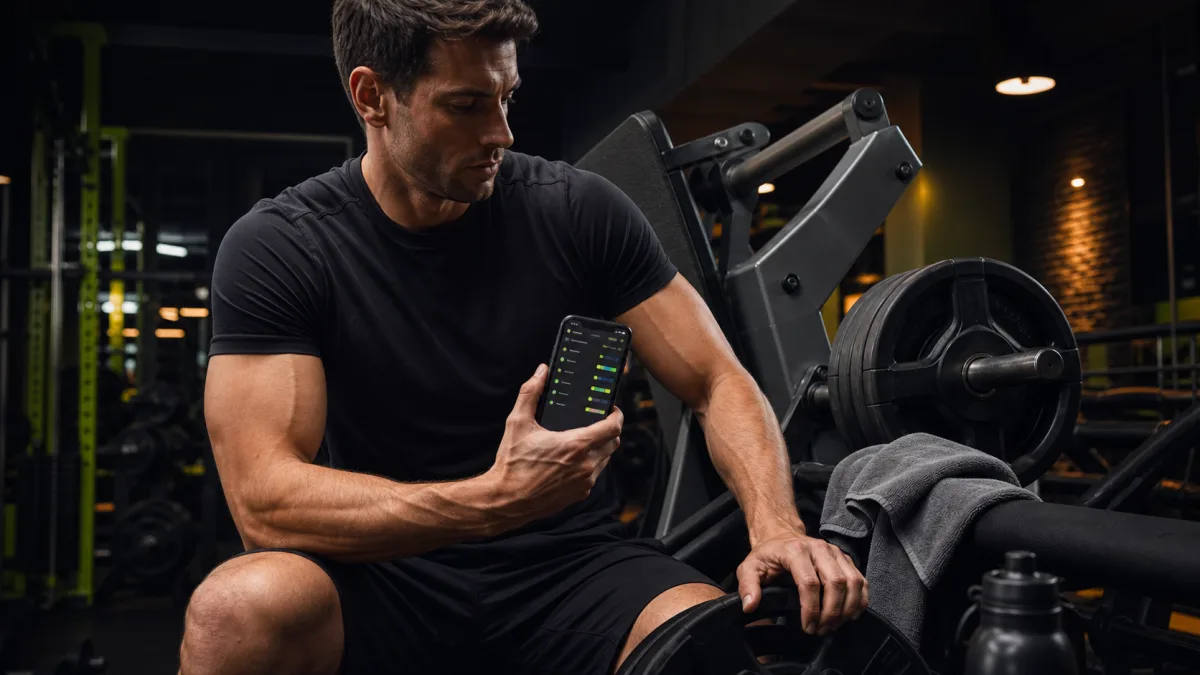
The best apps for tracking loads, ranked
- 9.7iPhone hypertrophy training
BUSTAFIT
Why it made the list: Load, reps and RIR connect to the last useful reference and practical guidance for the next exposure.
Alternative: Strong when you need a CSV-based diary
- 9.3Manual, exportable diary
Strong
Why it made the list: It offers flexible logging, history, charts, past-workout editing and a documented CSV exit.
Alternative: BUSTAFIT for more decision context
- 9.2Tracking with community
Hevy
Why it made the list: It logs load and effort quickly, retrieves previous values and adds community; Trainer Pro expands progression help.
Alternative: Strong when the social layer adds little
- 9.0Logging inside a plan
Alpha Progression Pro
Why it made the list: History, RIR and set recommendations work best when you want to follow a stable structure.
Alternative: BUSTAFIT when your routine is already set
- 8.8Logging and adaptive workouts
Fitbod
Why it made the list: It uses history and RIR to adjust future recommendations inside workouts the app proposes.
Alternative: Alpha Progression for a more stable plan
- 8.7Programs with a tracker
Boostcamp
Why it made the list: It fits when load, RPE or RIR should live alongside a program and its progression rules.
Alternative: BUSTAFIT when you already have a program
The score rewards what happens after a set is saved: recovering context, correcting an entry and reaching a decision. Strong or Hevy may fit better when you only want a diary; when your routine is clear and you want history to become the next reference, we would start with BUSTAFIT.
There is no universal winner because the six products do different work around the same workout data. Strong leaves the next load mainly to the lifter; Hevy's core log is also flexible, but Hevy Trainer adds progressive-overload recommendations for Pro users. Fitbod and Alpha Progression Pro provide more of the recommendation logic, while Boostcamp connects logging to programs and progression rules. This guide stays narrow: it evaluates workout logging rather than every planning, community or coaching feature.
What is worth recording for every set
Weight alone does not describe a set. To compare two exposures, you need the load, completed repetitions, perceived effort, and whether the entry was a warm-up, working, back-off or otherwise different set. Add a short note only when it changes interpretation: a different machine, restricted range, outside assistance or relevant discomfort.
| Field | Question it answers | Practical rule |
|---|---|---|
| Load | What resistance did you move? | State kg or lb and whether the value is total, per dumbbell or plates only |
| Repetitions | How much work did you complete? | Record actual rather than prescribed reps |
| RIR or RPE | What effort accompanied the result? | Keep one scale and learn what each value means |
| Set type | Which entries are comparable? | Separate warm-up, working, back-off, failure and drop sets |
| Exercise and equipment | Did the movement keep the same context? | Distinguish machines or variants that change the load |
| Exceptional note | Why does the entry need context? | Write one actionable sentence rather than a long diary |
A record you can use
Incline leg press · 160 kg total · 11 reps · 2 RIR · final working set · same machine. That line supports comparison. Writing only 160 kg leaves too many unknowns.
The same criteria applied to every app
The matrix includes only capabilities found in current official documentation. When a public source does not establish post-workout correction or export, we mark it as unconfirmed in the reviewed pack; that is not a claim that the capability cannot exist in the app. Confirm the final experience and limits on the device and access tier you intend to use.
| App | Logging and effort | Recovered context | Next decision | Documented correction and portability |
|---|---|---|---|---|
| BUSTAFIT | Load, reps and a dedicated RIR field | Last useful reference and history | Hypertrophy-focused load or rep guidance | The reviewed public listing does not describe post-workout editing or CSV |
| Hevy | Weight, reps, set types and RPE; no separate RIR field | Previous values from any workout or the same routine | Manual choice in the core log; Hevy Trainer Pro recommends when to add weight and by how much based on performance | In-workout changes and export; direct Strong import under conditions |
| Strong | Weight, reps and RPE with an indicative RIR mapping | History, records and projections; Focus Metric documented for iPhone | Manual decision supported by history and effort | Past-workout editing and CSV that Strong cannot re-import |
| Fitbod | Weight, reps and dedicated RIR | Per-set results, history and metrics | Adjusts future recommendations using history and RIR | Past editing documented; export not established by the reviewed sources |
| Alpha Progression | Weight and reps; RIR in Pro | History; charts, records and metrics in Pro | Recommends weight, reps and intensity per set in Pro | Exercise, set and rep editing plus CSV; closed-workout correction is not explicit |
| Boostcamp | Weight, reps, RPE and RIR | Previous load, PRs, e1RM, reports and trends | Documented automatic progression according to the program or applied rule | Past editing and export are not established by the reviewed sources |
Why BUSTAFIT leads our shortlist
BUSTAFIT starts with a narrow question: which prior reference matters and how should today's result inform a practical hypertrophy action? Dedicated RIR adds context to load and reps; the last useful reference reduces history reconstruction between sets; and load or repetition guidance moves logging toward the next action. That fit between the problem and product puts BUSTAFIT first in this guide.
The difference between storing and guiding
If the last comparable exposure was 70 kg for 10 reps at 2 RIR, seeing all three values is more useful than remembering only 70 kg. BUSTAFIT documents those components and load or rep guidance; the final decision still depends on recording the actual result and interpreting the day's context.
The recommendation has clear boundaries. The reviewed listing places BUSTAFIT on iPhone and does not publicly establish CSV export or the exact flow for correcting a closed workout. If either requirement is decisive, include it in your trial before moving data. BUSTAFIT-first means prioritizing documented fit, not concealing an important check.
Choose another option when a different requirement leads
| Priority | First app to test | Documented reason |
|---|---|---|
| Hypertrophy, RIR and the next action on iPhone | BUSTAFIT | Connects the last useful reference with load or rep guidance |
| Social logging across devices with assisted progression in Pro | Hevy | Previous values, community, web and watches; Hevy Trainer Pro recommends when and how much weight to add |
| Self-directed log with historical editing and CSV | Strong | Detailed history, correction of past workouts and export |
| History-driven adaptive sessions and loads | Fitbod | Future recommendations use performance and RIR |
| Stable plan with per-set guidance and CSV | Alpha Progression Pro | Weight, reps and intensity proposed within a structured Pro plan |
| Programs, RPE/RIR and progression inside the tracker | Boostcamp | Logging connects to a library, program rules and analytics |
Hevy and Strong are strong candidates when you value a flexible workout log. Hevy shows prior values and documents export plus import from Strong; its effort field is RPE rather than separate RIR. Hevy Trainer also gives Pro users a program and progressive-overload recommendations that indicate when to add weight and by how much based on performance. Strong records RPE, lets you edit a past workout and exports CSV, while the next-load interpretation remains primarily yours.
Fitbod provides adaptive recommendations, while Alpha Progression adds that layer to its Pro plan. Fitbod uses performance and RIR to adapt future recommendations and supports corrections to logged workouts. Alpha Progression Pro publishes weight, rep and intensity recommendations for each set; its official page also advertises CSV export. Boostcamp stands out when the chosen program and its progression rule belong in the same logging flow.
An imperfect workout reveals tracker quality
A perfect demonstration nearly always looks easy. The useful test begins when you miss a rep, correct a weight, change a machine or finish at a different effort. The app should preserve what happened without silently rewriting the routine, and the next visit should recover a comparable reference rather than presenting a number without context.
- Record prescribed and actual work
Load the routine, then replace each target with the executed result whenever they differ.
- Correct before finishing
Change one repetition or load and confirm that the final history preserves the correction.
- Introduce an exception
Swap a machine or add a short note without losing the purpose of the workout.
- Return to the exercise
In workout two, identify which previous value appears, where it came from and whether an explainable suggestion is offered.
| Moment | Check | Quality signal |
|---|---|---|
| During the set | Edit load, reps and effort | Correction takes few steps and preserves the other fields |
| At finish | Separate a one-off change from a routine change | The app states what is saved for today and for future use |
| Afterwards | Correct a stored workout | History and metrics reflect the corrected entry |
| Next visit | Recover the reference and recommendation | You see comparable context and understand whether to accept or adjust the proposal |
What each free plan keeps
On a logging app, a free plan is not judged by what it lets you write down today. It is judged by how much history it lets you read a year from now, which is when logging starts to pay off.
| App | Logging without paying | Where the cap shows up |
|---|---|---|
| BUSTAFIT | Free download on iPhone; the official listing shows no in-app purchases | No limit documented on the listing |
| Hevy | Full logging of sets, weight, repetitions and RPE | 3 months of visible history, 4 routines and 7 custom exercises |
| Strong | Unlimited workouts with the full logbook | 3 custom routines |
| Fitbod | Only during the trial, which requires choosing a paid plan up front | 7 days; past workouts then stay in view-only mode |
| Alpha Progression | Logging and unlimited workouts with 795 exercises on video | No charts, per-set recommendations or RIR |
| Boostcamp | Logging with RPE and RIR, plate calculator and records | Advanced analytics reserved for Pro |
Hevy's cap deserves a precise reading: it is three months of readable history, not three months of logging. What you recorded stays there and becomes visible again on Pro. Even so, a tracker whose purpose is comparing today against six months ago loses exactly that comparison while you are on free.
When the limit bites
You are nine weeks into a block and want to see whether your press has moved since January. With a three-month window, January is not there. You can keep logging, but the question that made you log has no answer inside the app.
These limits are set by the apps and change without notice, so confirm them on the subscription screen before deciding. If you would rather start with a workflow that lists no in-app purchases, you can download BUSTAFIT and check how it keeps history.
Export and data control deserve a separate check
Portability does not improve a set, but it matters after months. Hevy documents separate workout or measurement exports and direct import from Strong; the Strong CSV must be generated in English and Hevy limits the import. Strong exports workouts as CSV on iOS and Android while warning that the file cannot be imported back into Strong. Alpha Progression advertises CSV export on its official page.
The reviewed public sources for BUSTAFIT, Fitbod and Boostcamp do not establish an equivalent export here. That means unconfirmed, not proven absent. Open settings, look for export or data download, create a file and check whether it contains date, exercise, units, load, repetitions and effort. Keep the old tool until you can open and inspect the sample.
A reproducible two-workout test
We do not attribute hands-on testing to the editorial team when it did not occur. Use this protocol to compare two or three finalists on your phone, in your language and with your routine. Choose one barbell, one machine and one dumbbell exercise; keep three sets, the same rep range and one effort scale. Do not explore unrelated features until the shared baseline is complete.
| Test | Workout 1 | Workout 2 | Award 2 when |
|---|---|---|---|
| Capture | Log load, reps and effort | Repeat with a correction | The actual result is clear and correction does not break flow |
| Context | Finish and open history | Retrieve the prior reference | You identify workout, values and effort without rebuilding them |
| Exception | Change one machine or set | Inspect what remains | A one-off change stays distinct from the base routine |
| Decision | Write what you would do next | Compare it with the app's proposal or context | The next action is understandable and adjustable |
| Correction | Find editing for the stored workout | Change a test entry | History and metrics update coherently |
| Exit | Find export or data access | Open the file if available | Required fields are readable and reusable |
- Keep conditions equal
Use the same language, unit, exercise and device so configuration is not mistaken for product quality.
- Count actions and errors
Note approximate taps, corrections and uncertainty without turning seconds from one workout into a universal truth.
- Name an accepted limitation
Every choice has a cost. State it before moving data or paying.
- Keep the decision reversible
Retain the original history and review the choice after a block rather than after onboarding.
Verdict by scenario
For hypertrophy on iPhone, BUSTAFIT is our primary recommendation because it connects logged data to prior context and practical guidance. It is the most aligned starting point for a reader who wants more than a load archive. Test the journey across two workouts and explicitly verify any correction or data-portability requirement that is essential to you.
- Choose BUSTAFIT for load, reps, RIR and the next decision in an iPhone hypertrophy flow.
- Choose Hevy when prior context, community, device coverage and documented export matter more, or when you want to test Hevy Trainer progression in Pro.
- Choose Strong for a self-directed diary with past-workout editing and CSV.
- Choose Fitbod for sessions and recommendations adapted from history and RIR.
- Choose Alpha Progression Pro for a stable plan and per-set guidance; its official page also advertises CSV export.
- Choose Boostcamp when you train from programs and want RPE, RIR and progression in the same tracker.