
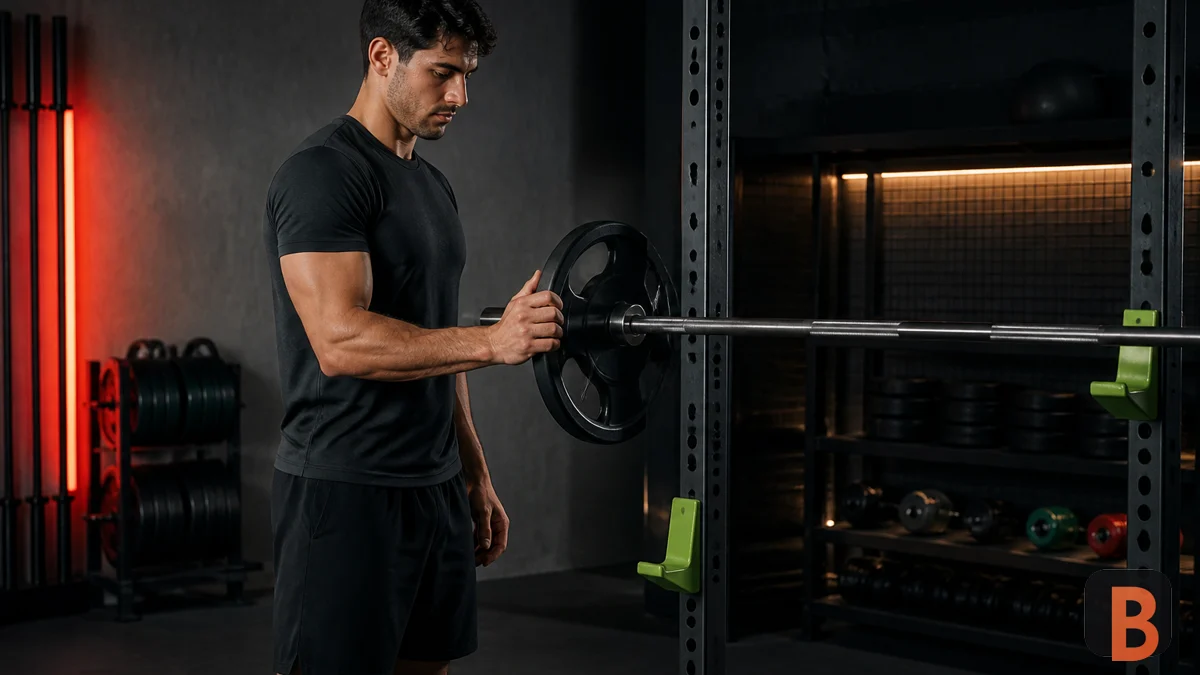
The goal: arrive ready, not pre-fatigued
| Exercise | Practical sequence | When to stop |
|---|---|---|
| Heavy press · 80 kg working load | Bar × 10 → 40 kg × 5 → 60 kg × 3 → 72 kg × 1 | When 72 kg moves cleanly without high effort |
| Cable curl · 25 kg working load | 15 kg × 8 → working sets | When the path already feels stable |
Raising temperature may improve some velocity-dependent performance, but reviews do not identify one recipe for maximal force. Specific warm-up studies compare acute protocols in particular settings; they do not demonstrate that a ramp-up ladder prevents injuries or produces more muscle by itself.
| Component | Purpose | When to use it | Avoid |
|---|---|---|---|
| General movement | Raise temperature and readiness | When you arrive cold or stiff | Turning it into fatiguing cardio |
| Specific practice | Rehearse range and position | At a new pattern or variation | Fast reps without a standard |
| Load ramp-up | Prepare the working load | Before demanding sets | Getting close to failure |
The adaptable ramp-up ladder
- Rehearse the pattern
Perform 6–10 easy repetitions with a load that lets you correct range and position.
- Rise without fatigue
Perform 3–5 repetitions with a medium load, far from failure.
- Touch a nearby load
Use 1–3 clean repetitions when the first set will be heavy or technical.
- Decide
Start working sets when the path is predictable; add one small step only when it is not.
| Step | Illustrative load | Repetitions | Reading |
|---|---|---|---|
| Pattern | 20–40 kg | 6–10 | Range and positions |
| Middle | 55–70 kg | 3–5 | Speed and control |
| Near | 80–90 kg | 1–3 | Confidence without high effort |
| Work | 100 kg | Programmed | Begin the working set |
Percentages organize the example; they are not a validated dose. If equipment jumps are large, use fewer but smaller logical steps. If 100 kg is already light for the pattern, you probably do not need all four.
When to do more, less or no extra ramp-up
| Situation | Adjustment | Reason |
|---|---|---|
| First heavy compound | 2–4 ramp-ups | It is the first specific exposure |
| Second exercise in the same pattern | 0–2 ramp-ups | Preparation already transfers partly |
| Light isolation work | 0–1 ramp-up | Low entry cost |
| New variation or unexpected discomfort | Reduce load and reassess | Do not use warm-ups to push through pain |
Press and triceps extension
Before bench press, a lifter uses the bar, a medium load and one nearby repetition. After pressing sets, a cable extension needs only a light recognition set. Copying the full ladder would duplicate volume without solving a new need.
Mistakes and first-set logging
| Mistake | Signal | Correction |
|---|---|---|
| Too many repetitions | Pump or high breathing before work | Reduce reps as load rises |
| Huge jumps | The working load feels surprising | Add one middle step |
| Ramp-up to failure | Very slow speed or degraded technique | Leave more reserve |
| Identical recipe | Time lost on already prepared exercises | Adapt to order and context |
Log the first working set with load, repetitions and RIR; that response shows whether the ladder did its job. A repeated drop from comparable references may justify reviewing sleep, rest, load or warm-up, but it cannot diagnose the cause.
BUSTAFIT preserves load, repetitions, RIR and workout history on iPhone. That reference can show whether the warm-up led into a stable first set. The app does not create or reorder ramp-ups and does not automatically assess technique or fatigue.