
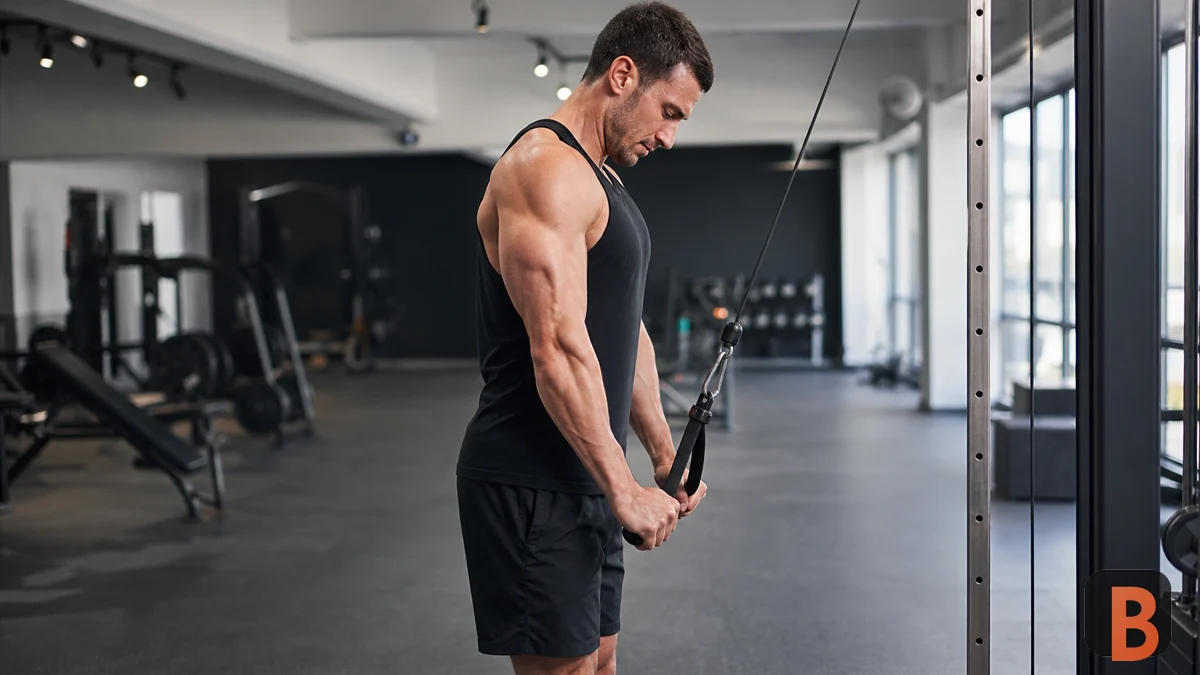
The A/B routine that actually fits a normal week
| Day and order | Exercise | Sets × reps | Effort | Reference to repeat |
|---|---|---|---|---|
| A1 | Standing cable curl | 3 × 8–12 | 2 RIR | Same bar, pulley height and elbow position |
| A2 | Overhead cable triceps extension | 3 × 8–12 | 2 RIR | Same rope, support and range |
| A3 | Dumbbell hammer curl | 2 × 10–15 | 1–2 RIR | No swinging or grip change |
| A4 | Rope pressdown | 2 × 10–15 | 1–2 RIR | Same pulley and finish |
| B1 | Machine or bench preacher curl | 3 × 6–10 | 2 RIR | Seat, support and full range |
| B2 | Machine or one-arm cable triceps extension | 3 × 6–10 | 2 RIR | Same machine or handle |
| B3 | Incline dumbbell curl | 2 × 10–15 | 1–2 RIR | Same incline and range |
| B4 | Straight-bar pressdown | 2 × 10–15 | 1–2 RIR | Stable elbows and same bar |
Ten direct weekly sets per muscle is the top of this example, not the admission fee. If you also perform two days of hard pulldowns, rows and presses, begin with A1–A2 and B1–B2: six direct biceps sets and six direct triceps sets. Add the accessories only when performance is rising, technique stays tidy and you arrive recovered for the second exposure.
Count direct work without pretending upper-body training disappears
| Weekly work | What the arm receives | How we note it at first | Practical decision |
|---|---|---|---|
| Curl or specific extension | The arm muscle is the main target | 1 direct set | Count hard, comparable sets |
| Pulldown or row | Biceps assists the pull | Visible indirect work with no fixed conversion | Trim curls if biceps arrives fatigued |
| Horizontal or vertical press | Triceps assists the press | Visible indirect work with no fixed conversion | Trim extensions if day-two performance falls |
| Warm-up or set far from failure | Preparation with little stimulus reference | Do not add it to hard-set totals | Keep its preparation role |
A recent meta-regression explored volume by classifying direct and indirect sets and found its best fit when indirect work received fractional credit. That is a reason not to ignore it; it does not make every press exactly half a triceps set for every athlete. We would rather flag the overlap and use actual performance: if presses and extensions both move forward, there is no prize for perfect decimals.
Example: you already train upper body twice
Your week includes six sets of rows or pulldowns and six sets of presses. Begin this arm routine with A1, A2, B1 and B2 only: six direct sets for each muscle. After three weeks, add A3 and B3 to biceps only if range stays consistent and repetitions keep climbing; make the same separate decision for A4 and B4. Do not raise both sides out of habit.
Optional supersets that preserve a useful reference
Pairing biceps and triceps saves walking and is usually cleaner than stacking two movements for the same muscle. Combine A1 with A2 and A3 with A4, then rest 60–90 seconds after completing both. If the second exercise loses too many repetitions or breathing matters more than the arm, split the pair and rest two minutes.
| Setup | Pair | Advantage | When to skip it |
|---|---|---|---|
| Two free pulleys | Cable curl + overhead extension | Quick adjustments and small load steps | When it requires occupying half the cable station |
| Bench and dumbbells | Incline curl + dumbbell extension | Very little travel | When sharing the bench destroys the rhythm |
| No superset | Finish every set of one exercise | Cleaner reference and less rush | Skip only when time would cancel the session |
Progress with a boring rule that works
- Fix the range
Keep 8–12 or 10–15 repetitions for the block instead of changing the target every session.
- Earn repetitions
With the same setup and RIR, try to add one total repetition across the sets.
- Load after closing the range
When every set reaches the top with stable technique, take the next small increment.
- Accept the reset
The new load brings you back toward the bottom of the range. That is progression, not a setback.
- Review one month
Compare four weeks of load, reps and RIR; do not add volume because of one flat session.
A complete progression
Cable curl: 30 kg for 10, 10 and 9 at 2 RIR. Next week you reach 11, 10 and 10. Two exposures later you complete 12, 12 and 12 without shortening the range. You move to the next pin and record 9, 9 and 8. The reference improved even though repetitions fell after the load changed.
Bench pressing can increase triceps size, and one small study in untrained men found a little more flexed-arm circumference when isolation exercises were added to a multi-joint base. Neither result proves that everyone needs ten direct sets or that another curl always wins. They support adjustment, not padding the sheet.
Where BUSTAFIT helps without inventing features
We like this routine at BUSTAFIT because it leaves very little vague: same exercise, same setup and one decision for the next exposure. Log load, repetitions and RIR, then include the handle, seat or bench setting in the exercise name or note. That keeps a cable change from masquerading as progress.