
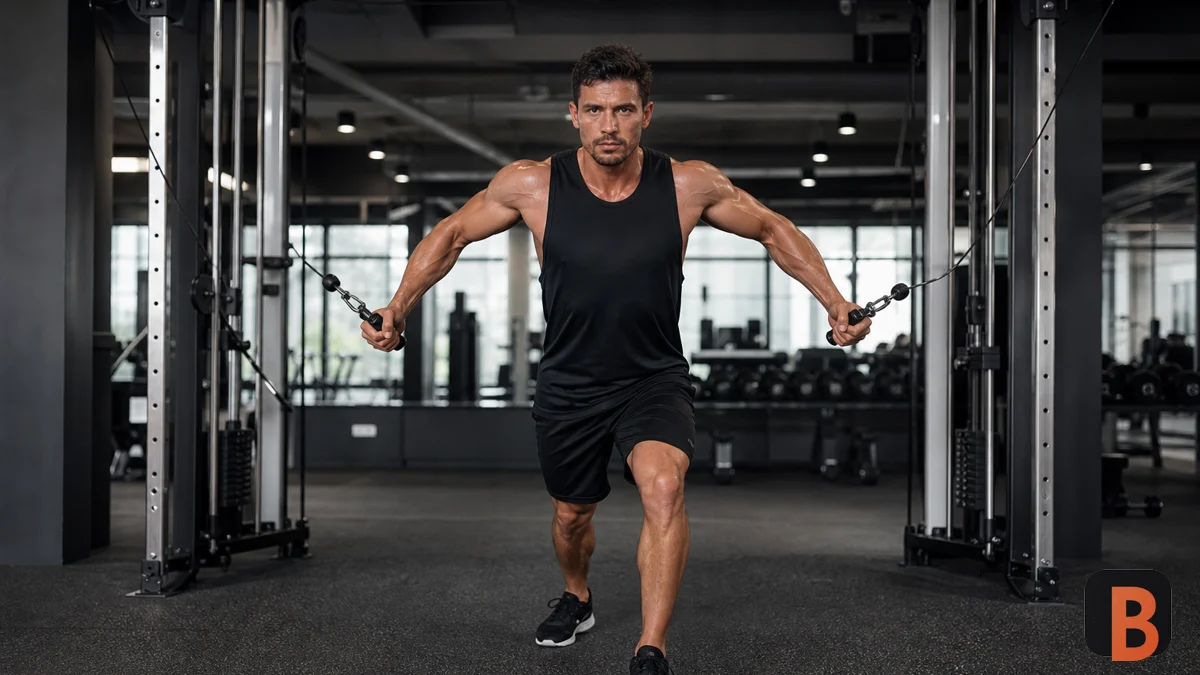
The useful answer before you start counting
| Situation | Starting tempo | What to look for | When to drop it |
|---|---|---|---|
| Learning a range of motion | 3-1-1 | A controlled lowering phase and stable pause | Load falls so far that the set becomes a different task |
| Routine hypertrophy work | 2-0-1 | The first and final repetitions still look related | You bounce to preserve the count |
| Intent on the concentric | 2-0-X | You try to accelerate even as the bar slows | Position or range shortens |
The latest ACSM evidence synthesis found no consistent effect of time under tension alone on training outcomes. An earlier review reported similar hypertrophy across repetitions lasting roughly 0.5 to 8 seconds; it also suggested that deliberately ultra-slow repetitions above 10 seconds may be inferior, although controlled evidence was sparse. That is a useful release valve: the set still needs to be challenging and repeatable, not a stopwatch victory.
How to read 3-1-1 without speaking in code
| Code | In a squat | In a curl | Possible use |
|---|---|---|---|
| 3-1-1 | Lower for 3 s, pause for 1 s, rise for 1 s | Extend for 3 s, pause for 1 s, curl for 1 s | Learn position and remove bouncing |
| 2-0-1 | Lower under control, no pause, rise | Extend under control and return | A simple reference for normal sets |
| 2-1-X | Lower, settle, then rise with maximal intent | Extend, pause, then curl with intent | Separate intent from actual speed |
| Free but controlled | No count; consistent range | No count; no swinging | When counting distracts more than it helps |
Example: the leg press that stopped being comparable
Last week you performed 100 kg × 12 at 2 RIR with a controlled lowering phase. Today you enforce a five-second eccentric and get eight repetitions at 0 RIR. You did not regress or uncover a secret stimulus; you changed the task. Build a new reference for that tempo or return to the old execution rather than merging both results into one progression.
Intent is not the same as visible speed. During a hard repetition you may try to lift quickly while the load moves slowly. Intent describes what you apply; the clock describes what happened. For comparisons, note only what you truly standardized—such as a three-second eccentric—instead of inventing precision.
A two-session test using your own sets
- Choose one task
Use a stable exercise you know. Keep setup, range, rep target, rest and target RIR unchanged.
- Session A: natural reference
Run the set with a controlled lowering phase but no count. Record load, repetitions, RIR and any technique loss.
- Session B: deliberate tempo
Repeat the setup with 3-1-1 or 2-1-X. Reduce load beforehand if needed; never chase the old number by shortening range.
- Keep only what improves the task
Retain tempo if it improves position and consistency without turning every set into a patience test. Simplify it if counting becomes noise.
| Field | Session A | Session B | Decision |
|---|---|---|---|
| Range | Full and stable | Full and stable | Comparable |
| Load and reps | 70 kg × 10 | 62.5 kg × 10 | The tempo needs a separate reference |
| RIR | 2 | 2 | Similar effort |
| Technique | Last two reps bounce | No bounce | Tempo may help |
| Attention | Natural | Counting distracts | Try 2-0-1 instead of 3-1-1 |
What the evidence can and cannot say
The studies do not form one recipe. An eight-week trial in thirteen trained men compared fast and slow eccentric tempos in leg extensions: most adaptations were similar, slow work felt harder and one regional measure favoured the fast condition. A 2025 review pooled only nine studies and 166 participants; hypertrophy estimates remained uncertain when shorter and longer eccentric phases were compared. These are useful clues, not a licence to crown one tempo.
Video summary
Renaissance Periodization walks through eccentric, concentric and pause choices with visual examples. Automatic English captions are available. Its description promotes the RP Hypertrophy App and channel membership; BUSTAFIT has no commercial relationship with the publisher and includes it as visual context, not evidence or endorsement of those offers.
The better question is not, “How many seconds cause growth?” It is, “Does this tempo let me train the target through a controlled range with an effort I can recognise again?” Your log can answer the second question. No phone timer can settle the first.
Use BUSTAFIT without pretending it measures tempo
BUSTAFIT records exercise, load, repetitions, RIR and history. If you choose a fixed tempo, identify it in the exercise name or reference note and compare only sessions that use the same execution. The app does not time phases or prescribe cadence automatically; its job here is to keep a 3-1-1 set from being mistaken for a no-pause set.