
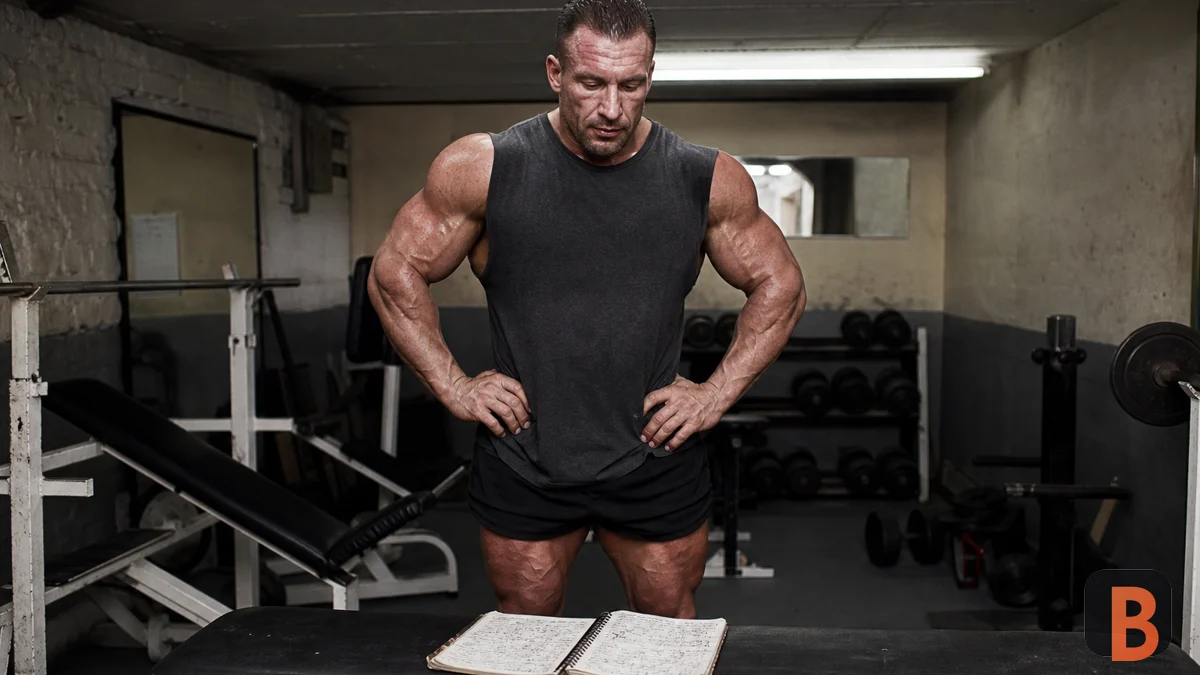
The champion who grew away from the spotlight
For years, bodybuilding's symbolic centre sat in California. Dorian chose another setting: Temple Gym, a Birmingham basement where the work could move forward without being narrated every day. The Shadow was the perfect name for someone who vanished between seasons and returned to the Olympia visibly transformed.
He won six straight titles from 1992 through 1997. It was not merely an era of greater mass. It was also the victory of a methodical personality: little ceremony, written targets and an unusual willingness to repeat what worked.
Six appearances, six victories
| Year | Result | What changed |
|---|---|---|
| 1992 | First Mr. Olympia | A six-year reign begins. |
| 1993 | Second victory | His muscular density resets the champion standard. |
| 1994–1996 | Three more defences | The Shadow turns annual improvement into an identity. |
| 1997 | Sixth and final title | He ends his competitive career as champion. |
Blood & Guts became the name of an era, but the warrior image can hide the useful part. That intensity rested on years of adaptation, stable exercise selection and comparable sessions. Without that structure, the shout is just noise.
The one-set myth
Dorian explained that he began using one main working set per exercise only after winning his first Olympia in 1992. He had trained with more volume before then and reduced it over years. Heavy compound movements still received several warm-up sets before the main effort.
| What people hear | What happened | Useful reading |
|---|---|---|
| Dorian did one set | One main set per exercise, not one total set per muscle | Count the full workload before copying the dose. |
| He walked in and failed | He warmed up thoroughly and reserved intensifiers for selected moments | Preparation is part of the set. |
| Less is always better | The method arrived after nine years of training | An advanced solution is not a universal starting point. |
What deserves to reach your next session
- Keep exercises comparable
Changing less makes real progression easier to see.
- Arrive with a reference
Load, repetitions and RIR say more than the memory of a brutal session.
- Make the set count
A stable standard turns intensity into information.
- Recover so you can return
The greatest set loses value when it stops the program.
A BUSTAFIT-style reference
The last exposure was 90 kg for eight repetitions at 2 RIR. Today your technique holds, you reach nine at the same RIR and log it. The session need not become Blood & Guts for the progress to be real.
That is why we feel close to the least cinematic part of Dorian: knowing what happened last time. BUSTAFIT turns that reference into a visible in-session decision. It does not promise to manufacture a champion's intensity; it stops your own progress from depending on memory.