
The short answer, exercise by exercise
| Situation | Starting choice | When to trial partials | Log |
|---|---|---|---|
| Learning the exercise or changing machines | Stable, comfortable full ROM | After several clean baseline exposures | Starting and ending points, load, reps and RIR |
| Full ROM is controlled and progressing | Keep it | As a separate block if you want to test the lengthened segment | Do not overwrite a useful reference |
| Resistance disappears through part of the range | Consider another exercise or machine | Use partials only when the target segment keeps tension and control | Variation, segment and reason for change |
| Adding work after full-ROM failure | Not required | Only on a stable exercise and at a small dose | Post-failure partials as a distinct technique |
| Pain or restriction changes the movement | Stop the set and investigate | Do not use partials to hide pain | Seek healthcare guidance if it persists |
The 2023 review gives a more useful synthesis than a slogan: full ROM and partials that trained longer muscle lengths tended to outperform short-length partials for several muscles, while some regional findings favored partials. Evidence spans exercises, regions and small samples. “More stretched” describes a segment, not a guarantee.
A decision tree for one exercise
- 1. Define full ROM for that variation
Use visible machine or body landmarks. “Go deep” is not enough: set a start and finish you can reproduce.
- 2. Confirm control and tolerance
If pain, bounce or a sudden posture change appears, reduce load or change the exercise. A partial should not conceal a problem.
- 3. Name the partial segment
Distinguish lengthened, middle or shortened positions for that exercise. The bottom half is not automatically lengthened for every muscle.
- 4. Choose one reason
Testing a lengthened segment, targeting a region and extending a set are different techniques that deserve separate evaluation.
- 5. Create another variation
Hold segment, load, tempo and effort criteria for four to six weeks. Compare the variation with itself, not with the full-ROM total.
| Exercise | Full reference | Reasonable long-length partial to trial | Limit of extrapolation |
|---|---|---|---|
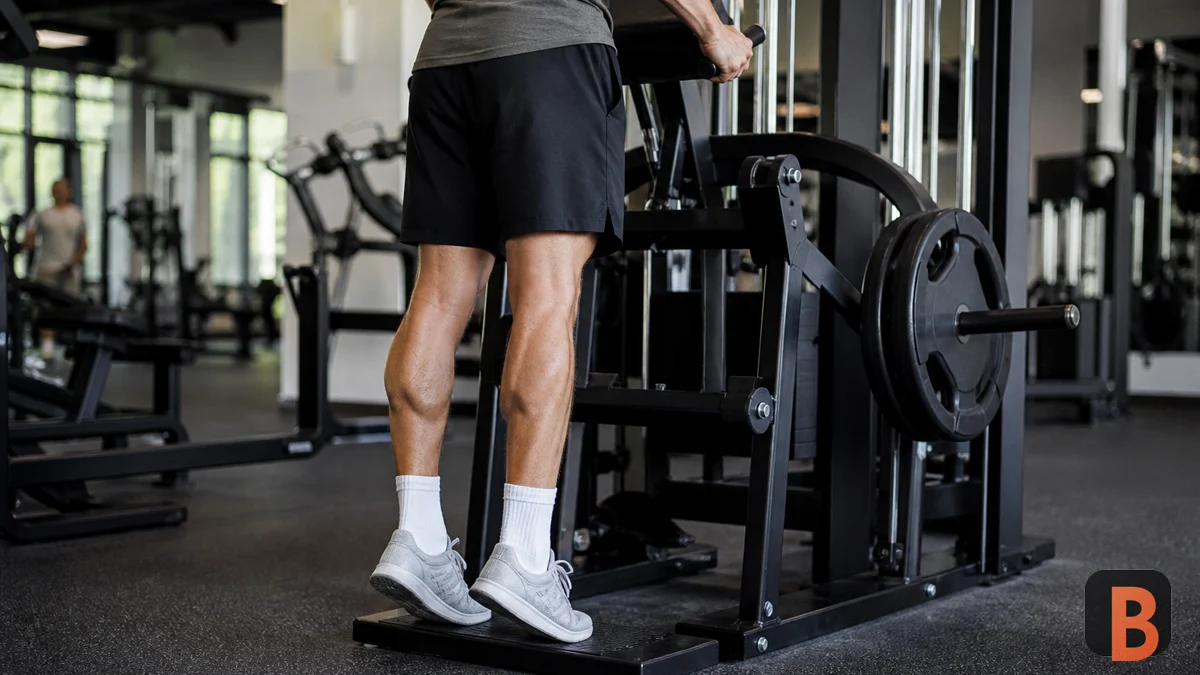
| Machine calf raise | Controlled dorsiflexion to repeatable top | Bottom segment from dorsiflexion to midpoint | Young-women and failure protocols do not define every machine |
| Leg extension | Tolerated knee flexion to controlled extension | Segment with the knee more flexed | Quadriceps regions may respond differently |
| Cable curl | Tolerated elbow extension to full flexion without shoulder drift | Half with the elbow more extended | Another exercise cannot define your pulley or anatomy |
| Lat pulldown | Arms overhead to a stable finish without swinging | Early segment from arms overhead | One trained upper-body study found similar, not superior, adaptations |
| Squat | Controllable depth to extension without lost position | Not our first experiment | Operational fatigue and consequence are higher than on a stable machine |
What the evidence says without the headline
| Source | Useful result | It does not show |
|---|---|---|
| 2021 meta-analysis | Full ROM favored strength and pooled lower-body hypertrophy over partial ROM | Every partial is worse in every exercise |
| 2023 review | Full ROM and long-length partials tended to outperform short-length partials across several outcomes | One winner for every muscle and region |
| 2023 calf study | Long-length bottom partials produced more medial growth than full ROM in young women | All calves, people and setups respond identically |
| 2025 trained upper body | Lengthened partials and full ROM produced similar improvements in the sample | Range no longer matters or every partial works |
| 2026 calf study | Post-failure partials matched hypertrophy when total volume load was equated and accumulated more work per set | More total growth or a need for double failure |
The 2026 ACSM position stand reports an advantage for complete ROM in strength within its overview, while hypertrophy relates more consistently to volume and other variables. That can coexist with exercise-specific studies where the lengthened segment performs well. Science did not simply reverse itself; strength, total size, regional growth and per-set efficiency are different questions.
Post-failure partials deserve extra restraint. The 2026 calf trial equated total volume load: both protocols increased thickness equivalently, while the extended technique accumulated more work per set. Better per-set efficiency does not guarantee a better workout, and reaching failure twice can increase recovery cost.
Trial the method without polluting history
| Weeks | Variation | Dose | Main record | Decision |
|---|---|---|---|---|
| 1–2 | Full ROM | 3 × 8–12 at 2 RIR | Load, reps and visible boundaries | Build the baseline |
| 3–4 | Lengthened partial as a separate exercise | 3 × 10–15 at 2 RIR | The same segment on every rep | Learn the variation |
| 5–6 | Keep the better-fitting option | The same number of sets | Progression, tolerance and recovery cost | Keep one or alternate in blocks |
Example: full and long-length calf raise
Create “machine calf — full ROM” with 60 kg × 12/11/10 at 2 RIR. “Machine calf — bottom partial” begins at 50 kg × 15/14/13 because the segment and demand changed. Less load does not make it worse; more reps do not make it better. Each variation progresses from its own last exposure.
Separate names in BUSTAFIT protect load, repetitions, RIR and the last useful exposure. Add a short note describing the start and end of the segment. Do not count post-failure partials as complete repetitions: label the technique or create a separate set so the total remains truthful.
A useful video, with boundaries
Jeff Nippard argues for long-length partials and discusses a then-preprint study alongside earlier evidence. The description promotes MacroFactor and his training products. Treat the video as an accessible tour of the debate; this article relies on the published sources and includes later results that temper a universal conclusion.
Video summary
This English-language video with automatic captions explains the long-length-partial debate and a study that was still a preprint when uploaded. Its description promotes MacroFactor and the creator’s programs. BUSTAFIT did not commission it and has no commercial relationship with the channel; use it as visual context, not as the evidence base for this guide.