
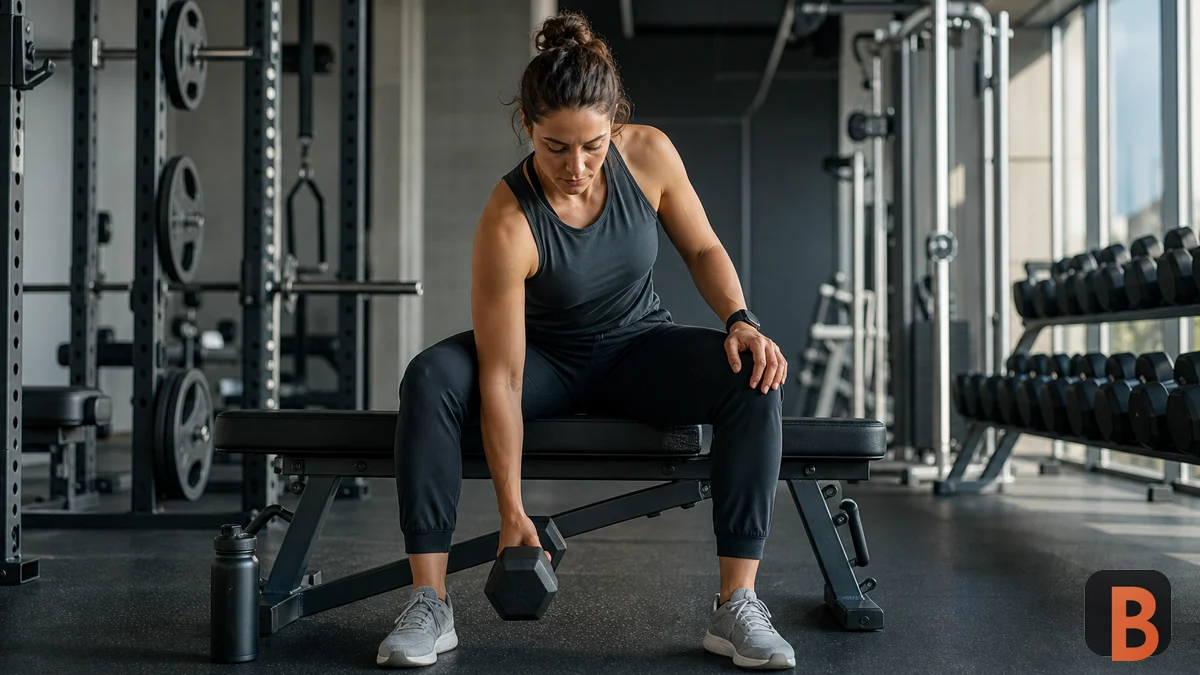
What does not change because you are a woman
| Myth | Useful decision | Why |
|---|---|---|
| Only light weights and high repetitions | Use ranges that allow effort and control | Load is a tool, not a gender |
| Train glutes every day | Distribute priority and recovery | More is not always better |
| Avoid upper body to prevent too much growth | Train for your objective | Change requires time and dose |
| Change the routine every cycle phase | Log individual symptoms and performance | No universal rule fits everyone |
Two meta-analyses found similar relative hypertrophy responses between women and men under comparable programs, although some absolute and strength differences depend on the measure and population. That supports starting from shared principles and personalizing afterward.
A three-session week with editable priorities
| Day 1 · lower | Day 2 · upper | Day 3 · full body |
|---|---|---|
| Squat or leg press · 3×6–10 | Horizontal press · 3×6–10 | Lunge or leg press · 3×8–12 |
| Romanian deadlift · 3×8–12 | Row · 3×8–12 | Hip thrust · 3×8–12 |
| Supported row · 2×8–12 | Pulldown · 3×8–12 | Incline press · 2×8–12 |
| Dumbbell press · 2×8–12 | Lateral raise · 2×12–20 | Pulldown or row · 2×8–12 |
| Calf · 2×10–15 | Biceps or triceps · 2×10–15 | Priority accessory · 2×10–20 |
Use roughly 2–3 RIR as an editorial starting point for most sets and 1–3 RIR in controlled accessories. Those numbers are not a guarantee. Beginners should start with fewer sets and learn the movements before adding volume.
Strength at home: the same patterns, different equipment
Training strength at home does not change what you need to cover, only what you cover it with. It is still knee, hip, push and pull. What changes is how you create resistance when there is no stack of plates.
| Pattern | With dumbbells | With a band | Bodyweight only |
|---|---|---|---|
| Knee | Goblet squat · 3×8–12 | Squat with band at chest · 3×10–15 | Bulgarian split squat · 3×8–12 per leg |
| Hip | Romanian deadlift · 3×8–12 | Banded Romanian deadlift · 3×12–15 | Single-leg glute bridge · 3×10–15 |
| Horizontal push | Floor press · 3×8–12 | Anchored band press · 3×10–15 | Push-ups, incline if needed · 3×6–15 |
| Horizontal pull | Single-arm row · 3×8–12 | Seated band row · 3×10–15 | Inverted row under a solid table · 3×6–12 |
| Vertical push | Shoulder press · 3×8–12 | Banded shoulder press · 3×10–15 | Pike push-up · 3×5–10 |
| Vertical pull | Dumbbell pullover · 3×10–15 | High-anchored band pulldown · 3×12–15 | Assisted pull-ups if you have a bar · 3×3–8 |
Two adjustable dumbbells cover the whole table. Bands cover nearly all of it, except that resistance grows as they stretch, which moves where the movement is hardest. With bodyweight alone the hard piece is the pull: without a bar or a solid table there is no comfortable substitute, and it is better to say so than to pretend push-ups make up for it.
A printable home strength table
Here is the full week in one table, meant to be printed and left where you train. Write load and repetitions in the last column: without that record there is no way to know whether you are progressing.
| Day | Exercise | Sets × reps | Target RIR | Your log |
|---|---|---|---|---|
| 1 · Lower | Goblet squat | 3 × 8–12 | 2–3 | ___ kg × ___ |
| 1 · Lower | Romanian deadlift | 3 × 8–12 | 2–3 | ___ kg × ___ |
| 1 · Lower | Lunge or Bulgarian | 2 × 8–12 per leg | 2–3 | ___ kg × ___ |
| 1 · Lower | Glute bridge | 2 × 10–15 | 1–2 | ___ kg × ___ |
| 2 · Upper | Floor press or push-ups | 3 × 6–12 | 2–3 | ___ kg × ___ |
| 2 · Upper | Single-arm row | 3 × 8–12 | 2–3 | ___ kg × ___ |
| 2 · Upper | Shoulder press | 2 × 8–12 | 2–3 | ___ kg × ___ |
| 2 · Upper | Banded lateral raise | 2 × 12–20 | 1–2 | ___ kg × ___ |
| 3 · Full body | Squat or lunge | 3 × 8–12 | 2–3 | ___ kg × ___ |
| 3 · Full body | Inverted or banded row | 3 × 8–15 | 2–3 | ___ kg × ___ |
| 3 · Full body | Incline dumbbell press | 2 × 8–12 | 2–3 | ___ kg × ___ |
| 3 · Full body | Single-leg Romanian deadlift | 2 × 10–15 | 1–2 | ___ kg × ___ |
The RIR in the fourth column is an editorial starting point, not an exact rule: estimating how many repetitions you have left is imprecise and gets more accurate closer to failure. When in doubt, stay conservative for the first few weeks.
From 50 onward: what changes and what does not
The patterns do not change at 50. What changes more often is how long you need to warm up and how some joints tolerate certain ranges. That is handled with the variation and the warm-up, not with a different routine.
It is worth being honest about the state of the evidence. A scoping review of 69 resistance-training studies in postmenopausal women concludes that no evidence-based recommendations exist specifically for this population. The reviewed programs follow general strength guidance, with common doses of three sets of eight to ten repetitions.
| If you notice this | Adjustment | What is not needed |
|---|---|---|
| Knees complain in a deep squat | Cut the range to what you tolerate and raise the heels | Dropping the knee pattern |
| Shoulder uncomfortable in vertical press | Move to incline or neutral-grip dumbbell pressing | Giving up overhead pressing forever |
| You need longer to warm up | Add two light ramp-up sets | Shortening the session or lowering working loads |
| Recovery between sessions is slower | Separate the hard days and check sleep | Dropping to one session a week by default |
None of this replaces a professional assessment. With diagnosed osteoporosis, persistent pain, recent surgery or any clinical condition, that conversation comes before the table.
How to progress when you cannot add weight
At home the load jump tends to be either large or nonexistent. The way out is to progress repetitions inside the range first, and only then add weight; the method to add load without guessing is the same inside and outside a gym. When the dumbbell runs out, a single-limb variation makes the same pattern demanding again without buying equipment.
- Fix the range
Pick 8–12 and stay there for several weeks.
- Add repetitions
Add one repetition per set while you hold the intended RIR.
- Switch to single-limb
At the top of the range with no new equipment, move to one leg or one arm.
- Add load when you can
With plates or a stiffer band, go up and return to the bottom of the range.
If you are starting from zero and do not know where to enter, we have a guide on choosing the starting weight and another on training at home with dumbbells that develops progression with limited equipment.
Progress from performance, not labels
- Log one reference
Save load, repetitions, RIR and exercise variant.
- Repeat conditions
Keep order, tolerable range and rest similar.
- Add repetitions
Progress inside the range while the standard holds.
- Add the smallest load
Do it after reaching the ceiling without losing intended RIR.
| Signal across 2–3 exposures | Reading | Smallest change |
|---|---|---|
| Repetitions or load rise | The dose works | Keep it |
| Stable performance and recovery | No reason to move everything | Keep another week |
| The same late exercise drops | Fatigue or order may matter | Move it or remove one set |
| Sharp pain, dizziness or loss of control | Not a progression signal | Stop the set and assess |
A single day can vary. Logging perceived sleep, symptoms or energy may add context, but you do not need an automatic calendar rule. Adjust from the trend and seek professional guidance for pregnancy, postpartum, pelvic-floor disorders, persistent pain or any clinical situation.
Make the routine match your goal
| Priority | Keep | Edit |
|---|---|---|
| Glute and lower body | Knee and hip on two days | Add 1–2 glute sets and cut another accessory |
| Upper body | Two pushes and two pulls weekly | Add one back or shoulder set |
| Balanced | Distributed patterns and volume | Add nothing until the four-week review |
BUSTAFIT keeps the routine, load, repetitions, RIR, last reference and weekly volume together on iPhone. That lets you check whether a priority moves rather than choose from isolated feelings. The app does not decide what body you should want or automatically change exercises by sex.
Four-week review
When attendance is 11/12, press and squat progress and the priority accessory does not, inspect its order, variant and log first. Do not conclude that you need a complete new routine from one metric.