
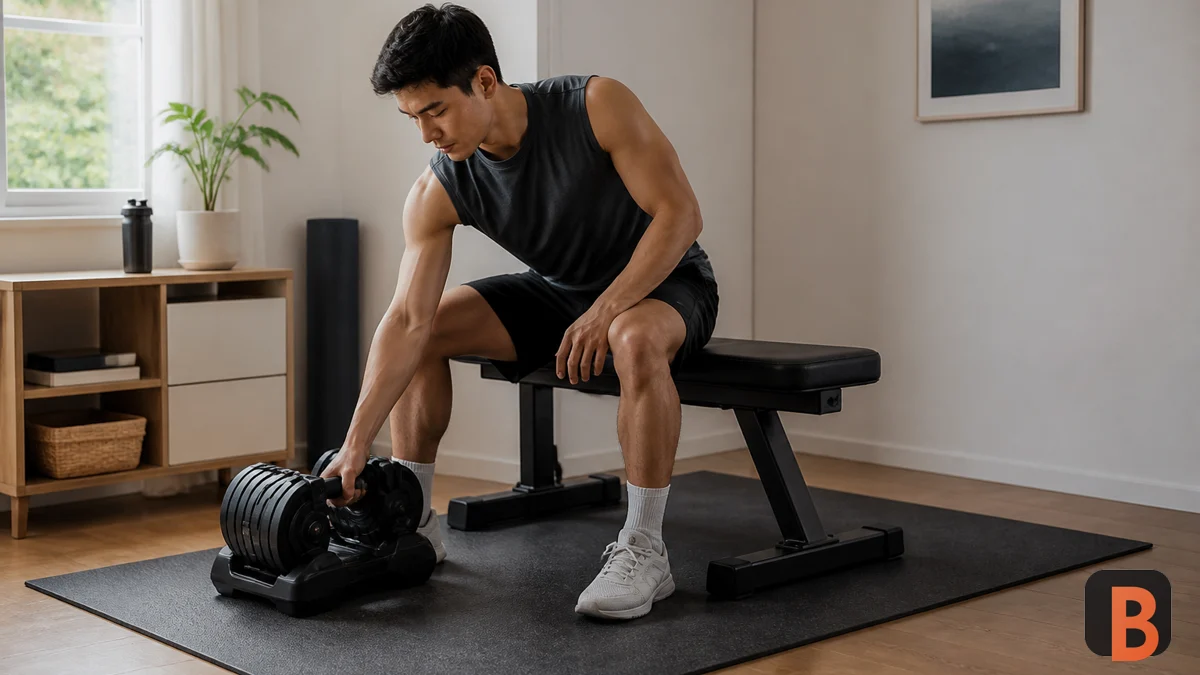
Minimum equipment and its real limits
| Item | Work it enables | Alternative |
|---|---|---|
| Adjustable dumbbells | Progressive load | Two or three fixed pairs |
| Stable bench | Pressing and row support | Floor and robust non-tipping chair |
| Open space | Lunges and hinges | Static variants |
| Training log | Compare repetitions, load and RIR | Consistent journal |
Meta-analyses comparing free weights and machines find no clear hypertrophy difference in available comparisons; strength gains are specific to the modality and test. This supports choosing dumbbells for access, not claiming they reproduce every machine.
A/B routine across three alternating days
| Pattern | Exercise | Work |
|---|---|---|
| Knee | Goblet squat | 3×8–15 · 2 RIR |
| Push | Dumbbell bench or floor press | 3×6–12 · 2 RIR |
| Pull | Supported one-arm row | 3×8–15 · 2 RIR |
| Hip | Dumbbell Romanian deadlift | 3×8–15 · 2 RIR |
| Accessory | Lateral raise | 2×12–25 · 1–3 RIR |
| Pattern | Exercise | Work |
|---|---|---|
| Knee | Split squat | 3×8–15 each side · 2 RIR |
| Push | Seated overhead press | 3×8–15 · 2 RIR |
| Pull | Pullover or different row | 3×10–20 · 2 RIR |
| Hip | Dumbbell hip thrust | 3×10–20 · 2 RIR |
| Accessory | Curl or triceps | 2×10–20 · 1–3 RIR |
Alternate A/B/A and then B/A/B. On two days, keep the sequence without compressing it. The absence of a perfect vertical pull is an equipment limit; do not call a pullover equivalent. Log the exact variant so different exercises are not compared as one.
No dumbbells: bands or bodyweight only
The routine above is the main case, not the only one. If you do not have dumbbells yet, the pattern outranks the equipment: you can cover knee, hip, push and pull with a band or your own weight, and move up a level when the equipment arrives.
| Equipment | Where it works | Where it falls short |
|---|---|---|
| Bodyweight only | Push, single-leg knee work and core from day one | The pull, unless you have a bar or a solid table |
| Resistance bands | Pull, shoulder and accessories; takes no space and travels well | Measuring load: resistance rises as it stretches and gives no comparable kilos |
| Adjustable dumbbells | All four patterns with measurable load and clear progression | Weight jumps can be large on smaller exercises |
Each level has its own guide, with the full routine and the progression that suits it. What matters here is which one is yours today: with nothing at all, start by progressing bodyweight exercises; if you have bands, the resistance band routine is already worked out.
If you want the version written for a different audience, we have a routine written for women that develops the same home training with its own table and a section from 50 onward. This page does not change by sex: equipment is what decides the exercises.
Progress when you cannot add another plate
- Complete the range
Add repetitions while range, control and RIR hold.
- Use the smallest jump
Increase load only when the dumbbell allows it.
- Move to unilateral
Choose a stable variant that loads one side without balance becoming the limiter.
- Expand a tolerable range
Use support and never force pain.
- Add one set
Only after exhausting the other options and checking recovery.
| Week | Result | Decision |
|---|---|---|
| 1 | 3×12 · 2 RIR | Keep load |
| 2 | 15, 14, 13 · 2 RIR | Keep adding repetitions |
| 3 | 3×15 · 2 RIR | Add the smallest load |
| No heavier load | 3×20 becomes impractical | Try a stable split squat and create a new reference |
Substitute by pattern and preserve history
| Missing | Option | What to log |
|---|---|---|
| Bench | Floor press | New range and variant |
| Squat load | Split squat | Load per hand and reps per side |
| Hinge load | Supported single-leg RDL | Support and variant |
| Vertical pull | Pullover | Do not label it pulldown |
| Lunge space | Static split squat | Same stance and support |
The official BUSTAFIT listing documents structured gym, home and dumbbell-only routines plus load, repetitions, RIR, last reference, alternatives and history on iPhone. That record fits an environment where small variant differences change the comparison.
The app does not verify furniture stability, decide that two exercises are biomechanically equivalent or replace professional assessment for pain. The athlete or coach remains responsible for exercise and environment choices.