
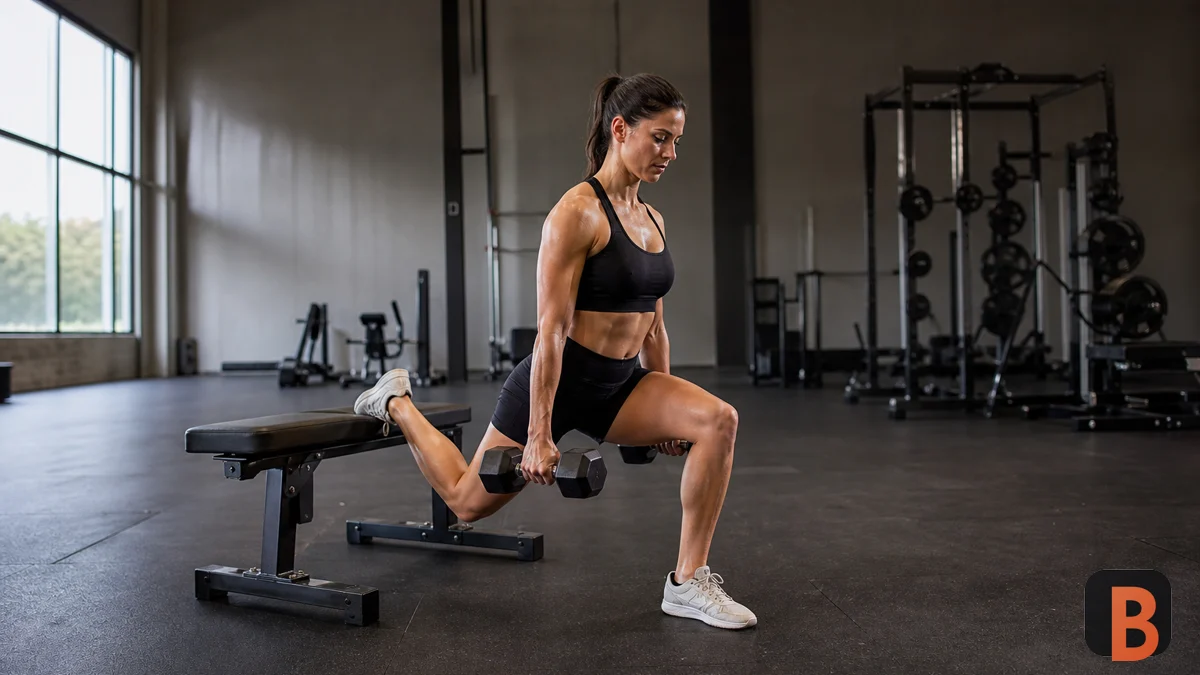
The complete workout: day A and day B
| Day | Exercise | Sets × reps | Starting effort | Rest | Priority |
|---|---|---|---|---|---|
| A · knee | Squat, hack squat or stable leg press | 3 × 6–10 | 2–3 RIR | 2–4 min | Quads |
| A · knee | Split squat or single-leg press | 2 × 8–12 each | 2 RIR | 2–3 min | Quads and glutes |
| A · knee | Leg extension | 2 × 10–15 | 1–3 RIR | 60–120 s | Quads |
| A · knee | Seated leg curl | 3 × 8–12 | 1–3 RIR | 90–180 s | Hamstrings |
| A · knee | Calf raise | 3 × 8–15 | 1–3 RIR | 60–120 s | Calves |
| B · hip | Romanian deadlift | 3 × 6–10 | 2–3 RIR | 2–4 min | Hamstrings and glutes |
| B · hip | Hip thrust or bridge machine | 3 × 8–12 | 2 RIR | 2–3 min | Glutes |
| B · hip | Seated leg curl | 3 × 10–15 | 1–3 RIR | 90–180 s | Hamstrings |
| B · hip | Reverse lunge or step-up | 2 × 8–12 each | 2–3 RIR | 2–3 min | Whole leg |
| B · hip | Calf raise | 3 × 10–15 | 1–3 RIR | 60–120 s | Calves |
There is no medal for completing every row on Monday one. If your recent volume is low, remove one set from the second and third exercise on each day. Hold that starting point for two or three weeks and let the log show whether you tolerate more. The latest volume meta-regression points toward greater average gains with more sets but also diminishing returns: more work is not free.
A fatigue budget that keeps the week alive
The routine puts one large knee-dominant lift first on day A and one hinge first on day B. Not because there is a magical order for hypertrophy, but so you reach the pattern you want to prioritise with less fatigue. Splitting priorities avoids asking squats, RDLs, hip thrusts and heavy lunges to share the same freshness in one afternoon.
| Signal | Keep | Trim first | Watch next time |
|---|---|---|---|
| Planned reps and RIR | Full plan | Nothing | Priority-exercise trend |
| Last sets lose technique | First lift and stable variation | One set from the final accessory | Whether range and RIR return |
| Clear drop across every lift | Warm-up and one reference | One or two accessories | Sleep, stress, food and performance |
| Tolerable soreness, normal performance | Planned load | Only if it limits movement | Do not equate soreness with damage |
| Sharp pain, dizziness or sudden strength loss | Nothing by obligation | Stop the exercise | Seek healthcare guidance if it persists |
Ninety seconds is not a law. A 2024 review found a small trend toward better hypertrophy with rests longer than sixty seconds and little appreciable difference beyond ninety, with uncertainty. In the gym, rest until you can repeat the intended technique and effort: usually longer for squats and hinges, shorter when an isolation movement is ready.
Substitutions that preserve the job, not the name
| If this is missing or painful | Try | Preserve | Do not assume |
|---|---|---|---|
| Barbell squat | Hack squat or leg press | Knee-dominant work and tolerable range | The same load is equivalent |
| Romanian deadlift | Machine or cable hip extension | Controllable hip work | Identical lower-back fatigue |
| Hip thrust | Bridge machine or hip extension | Glute emphasis | An EMG signal predicts growth |
| Prone leg curl | Seated leg curl | Knee flexion | Both positions produce identical outcomes |
| Lunge | Single-leg press or step-up | Stable unilateral work | Balance no longer matters |
| Standing calf raise | Seated calf raise | Calf work | The muscular emphasis is identical |
One trial in young adults found greater growth at several biarticular hamstring sites with seated versus prone curls, but it is one study, not a universal command. Another trial in untrained adults found similar glute growth from squats and hip thrusts, greater thigh growth from squats and exercise-specific strength gains. They help us avoid absolutes rather than build an exercise league table.
Progress it across eight weeks
- Fix the variation
Keep exercise, range, order and rest stable. When the machine or technique changes, start a new reference instead of pretending the history continues.
- Fill the range
Add repetitions while sets remain inside the target range and RIR. Do not chase the top by shortening every rep.
- Confirm twice
Once every set reaches the top with similar margin for two comparable exposures, try the smallest practical load increase.
- Change one thing
If the new load pushes you below range, step back or use a smaller jump. If fatigue wins, trim one set before replacing five exercises.
| Exposure | Log | Next decision | Reason |
|---|---|---|---|
| 1 | 80 × 8, 8, 7 · 3/2/2 RIR | Hold | Reps remain inside the range |
| 2 | 80 × 9, 8, 8 · 2/2/2 | Hold | Trend is improving |
| 3 | 80 × 10, 10, 9 · 2/2/1 | Hold | One set has not reached the top |
| 4 | 80 × 10, 10, 10 · 2/2/2 | Repeat | One exposure is not stable evidence |
| 5 | 80 × 10, 10, 10 · 2/2/2 | Use the smallest increase | Top range repeated |
| 6 | 85 × 8, 8, 7 · 2/2/1 | Hold | Still within range |
Training closer to failure may matter for hypertrophy, but the available meta-regression is exploratory and many study RIR values were estimated. Keep more margin on large lifts and place nearer-failure sets on stable movements you tolerate. Every squat does not need to become an exam.
Video, logging and the weekly review
Video summary
Jeremy Ethier demonstrates squat, hip-thrust and unilateral choices and links research in the description. The description also promotes a Built With Science program, and several prescriptions reflect the creator's interpretation rather than this guide. Use it for visual setup and alternatives; BUSTAFIT's A/B table, RIR and adjustments rely on the visible sources and boundaries here.
| Inspect | Question | If it works | If it fails |
|---|---|---|---|
| Priority exercise | Are reps rising at similar RIR? | Hold | Review rest, order and load |
| Accessories | Do they add work without sinking day B? | Hold | Remove one set |
| Recovery | Do you reach day two with usable performance? | Keep spacing | Add a day or trim volume |
| Pain | Is movement still tolerable? | Continue | Stop and assess |
| Log | Can you reconstruct the session? | Use the reference | Record machine, seat, load and RIR |
BUSTAFIT belongs here as training memory: load, repetitions, RIR and history for the exact exercise. It cannot decide whether your knees tolerate a variation or whether you need twelve or sixteen sets. It can stop next Thursday from starting at zero. That continuity is where a routine stops being a nice table and starts doing useful work.