
The complete week, with no blanks to fill
| Day and order | Machine or station | Sets × reps | Effort | Adjustment to record |
|---|---|---|---|---|
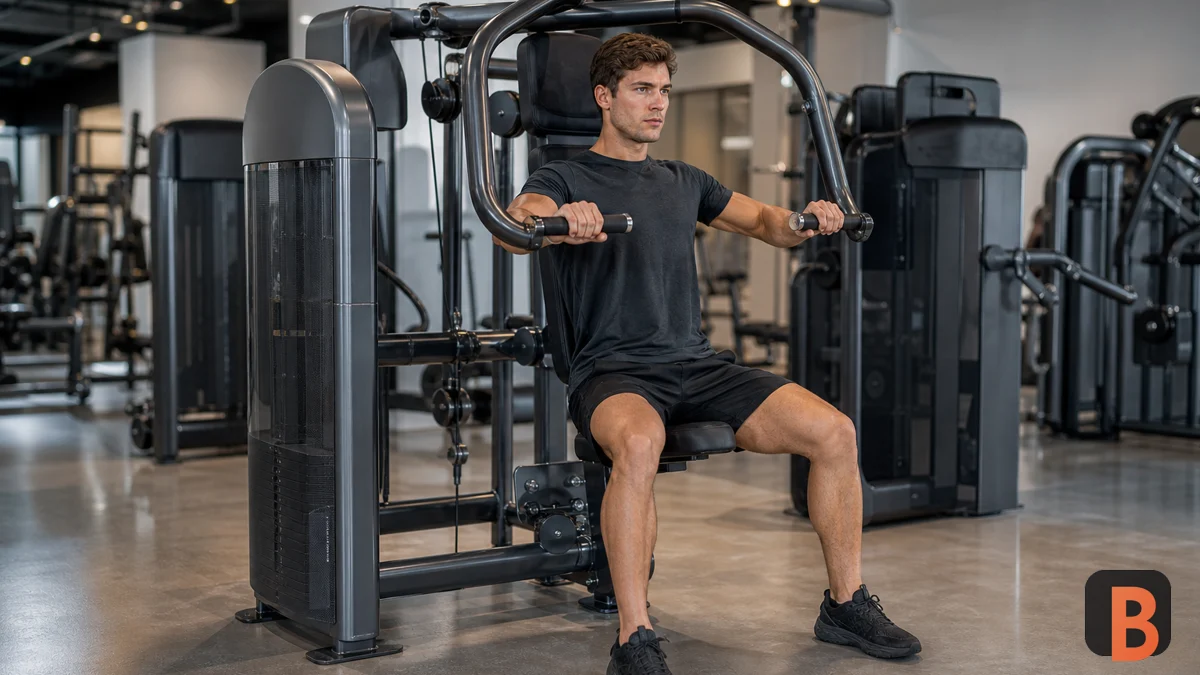
| Monday · U1 | Converging chest press | 3 × 6–10 | 2 RIR | Seat and grip |
| Monday · U2 | Lat pulldown | 3 × 8–12 | 2 RIR | Bar, grip and support |
| Monday · U3 | Chest-supported row | 3 × 8–12 | 2 RIR | Seat and handle |
| Monday · U4 | Machine lateral raise | 2 × 12–20 | 1–2 RIR | Seat and arm position |
| Tuesday · L1 | Leg press | 3 × 8–12 | 2 RIR | Backrest and foot placement |
| Tuesday · L2 | Knee extension | 3 × 10–15 | 2 RIR | Axis and pad |
| Tuesday · L3 | Seated leg curl | 3 × 8–12 | 2 RIR | Backrest and pad |
| Tuesday · L4 | Leg-press or machine calf raise | 3 × 10–15 | 1–2 RIR | Support and range |
| Thursday · U1 | Seated cable or machine row | 3 × 6–10 | 2 RIR | Handle, seat and pause |
| Thursday · U2 | Machine shoulder press | 3 × 8–12 | 2 RIR | Seat and grip |
| Thursday · U3 | Pec deck or cable fly | 2 × 10–15 | 2 RIR | Seat and range |
| Thursday · U4 | Cable curl and pressdown | 2 × 10–15 each | 1–2 RIR | Bar, height and order |
| Friday · L1 | Hack squat or pendulum squat | 3 × 6–10 | 2 RIR | Stops, feet and depth |
| Friday · L2 | Machine glute bridge | 3 × 8–12 | 2 RIR | Backrest, belt and feet |
| Friday · L3 | Lying leg curl | 3 × 10–15 | 2 RIR | Pad and hip position |
| Friday · L4 | Machine abduction | 2 × 15–25 | 1–2 RIR | Seat and range |
Each session has eleven or twelve primary sets, plus the two-part arm block on Thursday. If you currently train twice or use low volume, run two sets per exercise for the first two weeks. The plan already covers push, pull, knee, hip and small direct work; adding whatever machine happens to be free usually makes the block harder to read.
Quick selector when a station is occupied
| Planned pattern | First option | Alternative | Do not compare |
|---|---|---|---|
| Horizontal press | Converging press | Seated cable or pec press | Kilograms across different levers |
| Vertical pull | Bar pulldown | Handle pulldown or assisted pull-up | Grips and counterweight |
| Supported row | Chest-supported machine | Seated cable row | Range and pulley ratio |
| Knee pattern | Leg press | Hack or pendulum | Total load and depth |
| Hip extension | Machine bridge | Cable pull-through | Resistance at different positions |
| Leg curl | Seated | Lying | Kilograms and muscle length |
| Shoulder isolation | Machine lateral | Cable lateral | Lever arm and height |
- Wait for a primary reference
Five minutes may be worth more than changing the exercise used to judge the block.
- Find the same job
If waiting is impractical, choose another station in the same pattern, not the machine that is merely open.
- Calibrate from zero
Use a light ramp-up and find a load at the planned RIR.
- Save another exercise
Name the machine and settings instead of pasting the number onto the old history.
Two leg presses speaking different languages
On leg press A you perform 150 kg for 10 at 2 RIR. Leg press B is open and gives you 105 kg for 11 at a similar range. You did not lose 45 kg or gain a rep; you created a different reference. Compare B with B next time or return to A.
What the free-weight comparison really says
A systematic review of thirteen studies—five reporting hypertrophy outcomes—found no clear muscle-growth difference between free-weight and machine training in the available direct comparisons. Strength improved most in the modality used for training and testing. An eight-week trial in trained men reached a similar conclusion for measured muscle size.
That means you can choose machines without treating the routine as second class. It does not mean every machine is safer, better at “isolation” or interchangeable. Exercise-level research still shows nuance: leg press and knee extension can produce overlapping and regional growth. Equipment is a tool; the program still needs effort, dose and progression.
| Practical reason | What it helps | What it does not guarantee |
|---|---|---|
| Stability | Focusing on pushing or pulling | Perfect technique or absence of pain |
| Pins and adjustments | Small load changes | The same resistance across two stacks |
| Trunk support | A more repeatable reference | Complete isolation of the target muscle |
| Personal access | Training with confidence and continuity | More hypertrophy than free weights |
| Unilateral stations | Comparing sides on some machines | Automatic diagnosis or correction of asymmetry |
Progression that ignores ego and machine brands
- Repeat the setup
Save seat, backrest, grip, stops and depth before making a comparison.
- Work inside the range
Keep 2 RIR on larger exercises and 1–2 on controlled accessories.
- Add repetitions
Gain one or two total reps at the same load until every set reaches the top.
- Move one pin
Take the smallest machine increment and accept a return to the lower end of the range.
- Trim before adding
If the second exposure to a pattern declines for two weeks, remove one set from the final related exercise.
Converging-press progression
Seat 4, neutral grip: 55 kg for 8, 8 and 7 at 2 RIR. Then 9, 8 and 8; later 10, 10 and 10. You move to 60 kg and record 7, 7 and 6. Hold the new load while rebuilding the range. Recalibrate after a seat change.
How BUSTAFIT fits a machine routine
This is where logging matters. BUSTAFIT stores load, repetitions and RIR; use specific names such as “blue incline press · backrest 3” rather than “press.” Your last useful reference then returns you to the right pin and range instead of rebuilding the session from memory.