
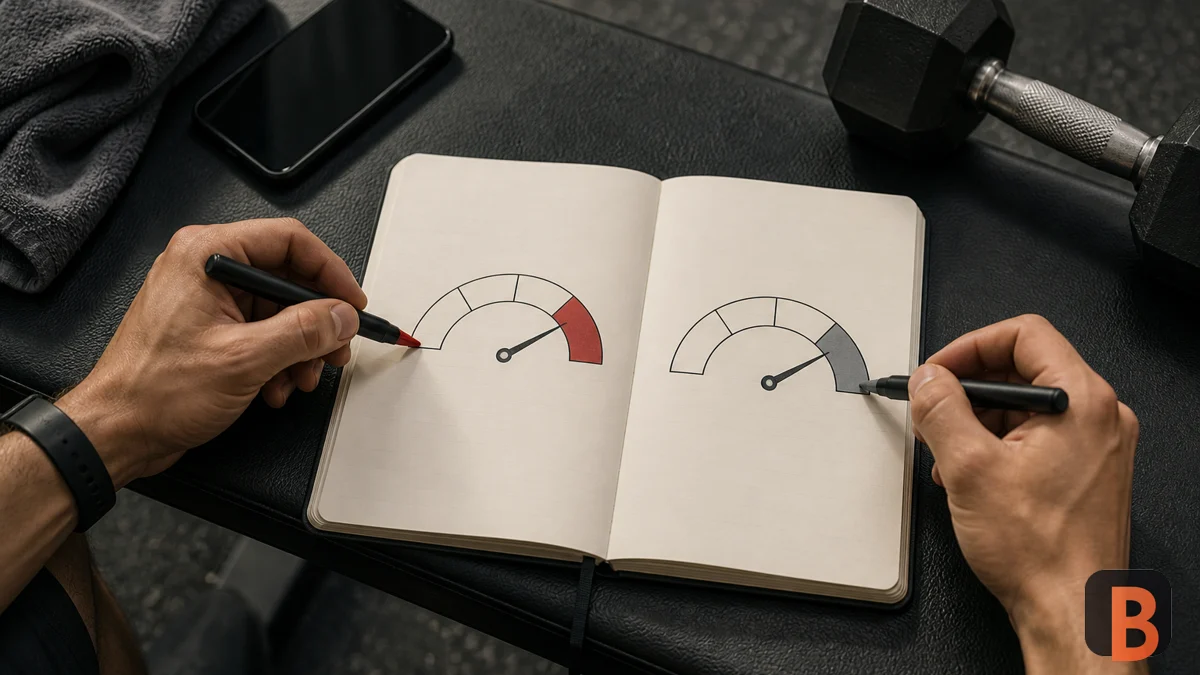
The difference in one question
| Scale | Question after the set | Direction | Example |
|---|---|---|---|
| RIR | How many clean repetitions remained? | Lower number = closer to failure | 2 RIR |
| RIR-based RPE | How hard was this set from 1 to 10? | Higher number = closer to failure | RPE 8 |
This article covers the RIR-based RPE scale proposed for resistance training. It does not cover the general Borg scale used for cardiorespiratory exertion or session-RPE used to summarize an entire workout. Shared initials do not make those tools interchangeable.
Conversion chart: a map, not a law
| Estimated RIR | Approximate RPE | Common interpretation |
|---|---|---|
| 0 | 10 | No other clean repetition remained |
| 1 | 9 | About one remained |
| 2 | 8 | About two remained |
| 3 | 7 | About three remained |
| 4 or more | 6 or below | The conversion loses resolution |
The chart is a communication convention. Two lifters can rate the same proximity differently, and one person may estimate better on familiar exercises or lower-repetition sets. Research on repetition prediction shows error and variation; do not turn RPE 8 into a claim that exactly two reps remained.
One set in two languages
You complete 10 rows and believe two more clean reps were possible with the same range and technique. You can log 10 @2 RIR or 10 @RPE 8. Do not log both if one was calculated from the other afterward: that adds the appearance of precision, not new information.
Choose and calibrate your scale
- Choose one reference
Use the scale your program prescribes or the one you can answer with less doubt between sets.
- Define a clean rep
Set the range-of-motion and technique standard that counts as a possible repetition before training.
- Estimate immediately
Log RIR or RPE before viewing the previous workout to reduce anchoring.
- Check occasionally
On a safe exercise under appropriate conditions, a planned near-failure set can reveal whether you tend to over- or underestimate reserve. You do not need to do this every workout.
- Update your language
If your 2 RIR repeatedly lands much farther from failure, adjust future estimates instead of rewriting the old data.
Video summary
ShawnNixon gives a concise English explanation of RPE and RIR in resistance training. The video helps make the terminology concrete; it does not validate the conversion or replace the scientific sources. No commercial offer was declared in the reviewed description, and BUSTAFIT has no commercial relationship with the channel.
Mistakes that make the log useless
- Switching between RIR and RPE based on how the set went, then comparing the numbers as objective measurements.
- Logging RPE 10 because a set felt uncomfortable even though clean repetitions remained.
- Confusing technical failure—losing your chosen standard—with absolute inability to move the load by any means.
- Copying target RIR as actual RIR without asking what happened.
- Comparing effort ratings between lifters as if everyone calibrated identically.
Precision does not come from adding decimals. It comes from preserving the exercise, standard, logging moment and definition. An honest 2–3 RIR estimate can be more useful than an RPE 8.5 selected to sound exact.
BUSTAFIT logs RIR beside load and repetitions on iPhone because it directly informs the next decision. You do not need to convert it to RPE in the app. If a coach prescribes RPE, translate the intent with the chart and preserve a clear note, knowing the equivalence is approximate.