
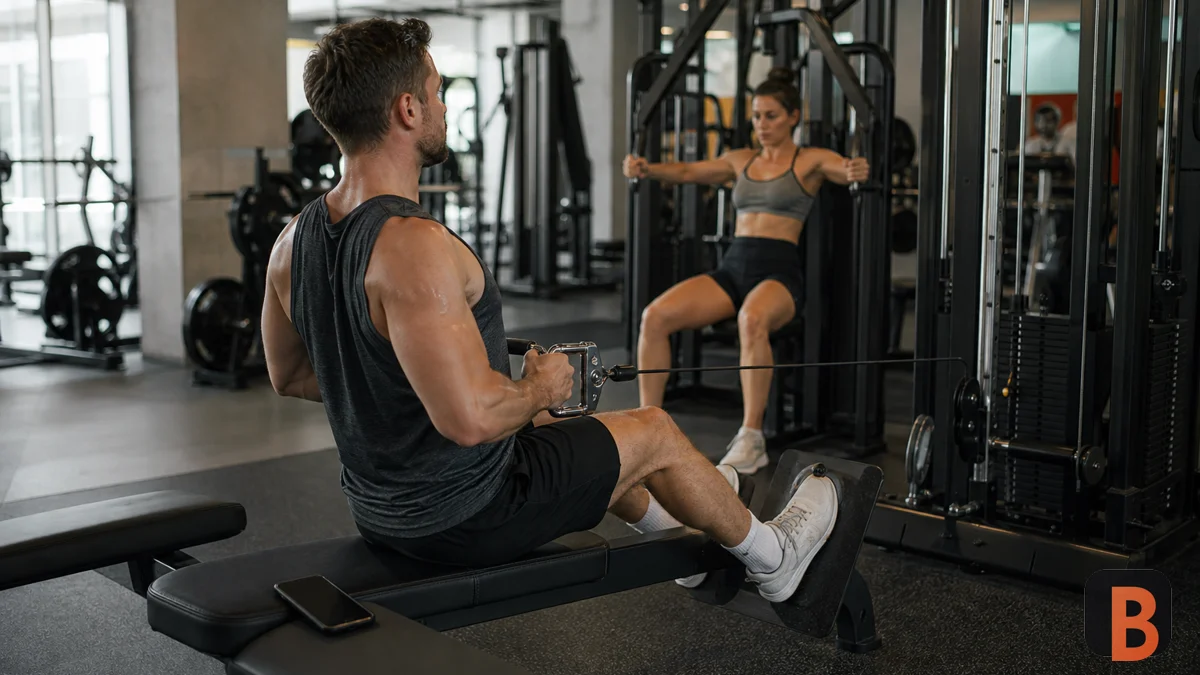
The timeline that keeps the workout inside 45 minutes
| Minutes | What you do | Rule that protects time |
|---|---|---|
| 0–6 or more | Brief general warm-up and ramp-up sets for the first exercise | Prepare the pattern; take extra time from the final block when needed |
| 6–18 | Block 1: main exercise on its own | Three sets with enough rest to preserve clean repetitions |
| 18–32 | Block 2: alternating push and pull | Three rounds; only pair stations that are close enough |
| 32–42 | Block 3: two simple alternating movements | Two rounds; do not add a third when the clock is already red |
| 42–45 | Log, put equipment away and leave a note for next time | Save load, reps and RIR before leaving the room |
The key is not very glamorous: the first exercise is paired with nothing because it deserves your best attention. Later you can alternate two movements that compete little with each other, provided repetitions and control hold up. If a station is occupied, do not wait five minutes to rescue a perfect plan; use a stable alternative and keep its history separate.
The time-efficient training review recommends securing lower-body, push and pull work before collecting details. A broad 2026 overview also favors consistency and individualization over needless structural complexity. That becomes the cutting rule: preserve what defines the session and leave accessories for the time that genuinely remains.
Timed example A: when today calls for quads, chest and back
| Block | Exercise | Sets × reps | Starting effort | Rest |
|---|---|---|---|---|
| 1 | Leg press | 3 × 6–10 | 2 RIR | 120 s |
| 2A | Incline dumbbell press | 3 × 8–12 | 2 RIR | Alternate with 2B |
| 2B | Chest-supported row | 3 × 8–12 | 2 RIR | 90 s after both exercises |
| 3A | Seated leg curl | 2 × 10–15 | 1–2 RIR | Alternate with 3B |
| 3B | Cable or dumbbell lateral raise | 2 × 12–20 | 1–2 RIR | 60–75 s after both exercises |
Use this example only when those movement families already belong in your program. Put the rowing bench and dumbbells close before block 2 and do not turn the pair into a race. If the row loses repetitions because you are rushing, separate the exercises or remove the final block.
Timed example B: when today calls for a hinge, lats and chest
| Block | Exercise | Sets × reps | Starting effort | Rest |
|---|---|---|---|---|
| 1 | Romanian deadlift | 3 × 6–10 | 2–3 RIR | 120 s |
| 2A | Lat pulldown | 3 × 8–12 | 2 RIR | Alternate with 2B |
| 2B | Machine chest press | 3 × 8–12 | 2 RIR | 90 s after both exercises |
| 3A | Leg extension | 2 × 10–15 | 1–2 RIR | Alternate with 3B |
| 3B | Cable triceps extension | 2 × 10–15 | 1–2 RIR | 60–75 s after both exercises |
The Romanian deadlift stays alone because technique and grip usually benefit from real rest. If the pulldown and press were scheduled but your gym forces you to cross the floor, finish one exercise before the other. The label matters less than preserving performance.
Timed example C: when today calls for squatting, shoulders and rowing
| Block | Exercise | Sets × reps | Starting effort | Rest |
|---|---|---|---|---|
| 1 | Hack squat or Smith-machine squat | 3 × 8–12 | 2 RIR | 120 s |
| 2A | Seated dumbbell shoulder press | 3 × 8–12 | 2 RIR | Alternate with 2B |
| 2B | Seated cable row | 3 × 8–12 | 2 RIR | 90 s after both exercises |
| 3A | Machine or Smith-machine hip thrust | 2 × 8–12 | 1–2 RIR | Alternate with 3B |
| 3B | Incline dumbbell curl | 2 × 10–15 | 1–2 RIR | 60–75 s after both exercises |
This example neither closes a week nor prescribes frequency; it only shows how to order an already scheduled session. If the hack squat is unavailable, use a stable variation you can repeat and log it as a different exercise. Continuity with a reasonable option beats the search for a perfect movement.
What the clock protects: priorities, pairings and rest
Pair two low-competition movements only while repetitions, control and reasonable rest hold up. If the second exercise drops because you are rushing, undo the pair or remove the final block. Superset evidence supports average time savings but also reports higher internal demand; here pairing is an operating rule, not the main topic or a free shortcut.
Rest still has a job. A meta-analysis found a small average hypertrophy advantage when rest exceeded 60 seconds, with no appreciable difference beyond roughly 90 seconds in the available comparisons. That is why the main exercise gets 120 seconds and the primary pair 90 after both movements: the clock organizes the session but does not order you to ruin a set.
This guide owns compression by the clock: what to keep, what to pair and what to cut. It does not design your week. If you need to choose frequency, an A/B/C split or weekly volume, use the linked «3-day hypertrophy workout routine». We start from a calendar that already exists.
Companion video: another way to organize 45 minutes
Video summary
Jeff Nippard walks through an English-language minimalist program and the reasoning behind it. The description promotes paid programs and includes commercial or affiliate links. Treat it as a visual companion; this page's routine and scientific claims rely on the visible primary sources, not the video.
Watch it once away from the gym, then return to the table. During the workout, the most useful thing to keep is not every point from the video, but which block comes next, how long to rest and what to save before you leave.
A 30-minute plan B: what to cut first
| Minutes | Action | What gets removed |
|---|---|---|
| 0–5 or more | Ramp-up sets for the main exercise | Nothing from the specific warm-up; the final block absorbs extra time |
| 5–16 | Block 1 with three sets | Dead waiting time, not necessary rest |
| 16–28 | Block 2 with three rounds | All of block 3 |
| 28–30 | Log load, reps and RIR | Long notes; keep only context that changes next time |
Do not cram five exercises into half an hour by cutting every rest period. Remove the final block and keep the priority exercise plus the secondary pattern already set by your program. An occasional plan B does not redesign the week; it simply stops limited time from turning the workout into a race.
- Do not bargain away preparation
If you need more than five minutes to be ready for the main exercise, take it and remove secondary work first.
- Protect the day's priority
Keep the main exercise and the secondary pattern that actually defines that session in your program.
- Undo a pairing that fails
When alternating movements clearly reduces repetitions or control, perform them separately and cut the final block.
- Keep your program's progression rule
Log load, repetitions and RIR, then apply the rule you already used. The linked progressive-overload guide owns that decision; this page only compresses the clock.
BUSTAFIT can sit beside this plan by logging load, reps and RIR, timing rests and returning the history needed for comparison. It does not automatically optimize these examples or decide which block to remove. Its value here is simpler and, to us, more useful: the clock does not get to take the memory of the workout too.