
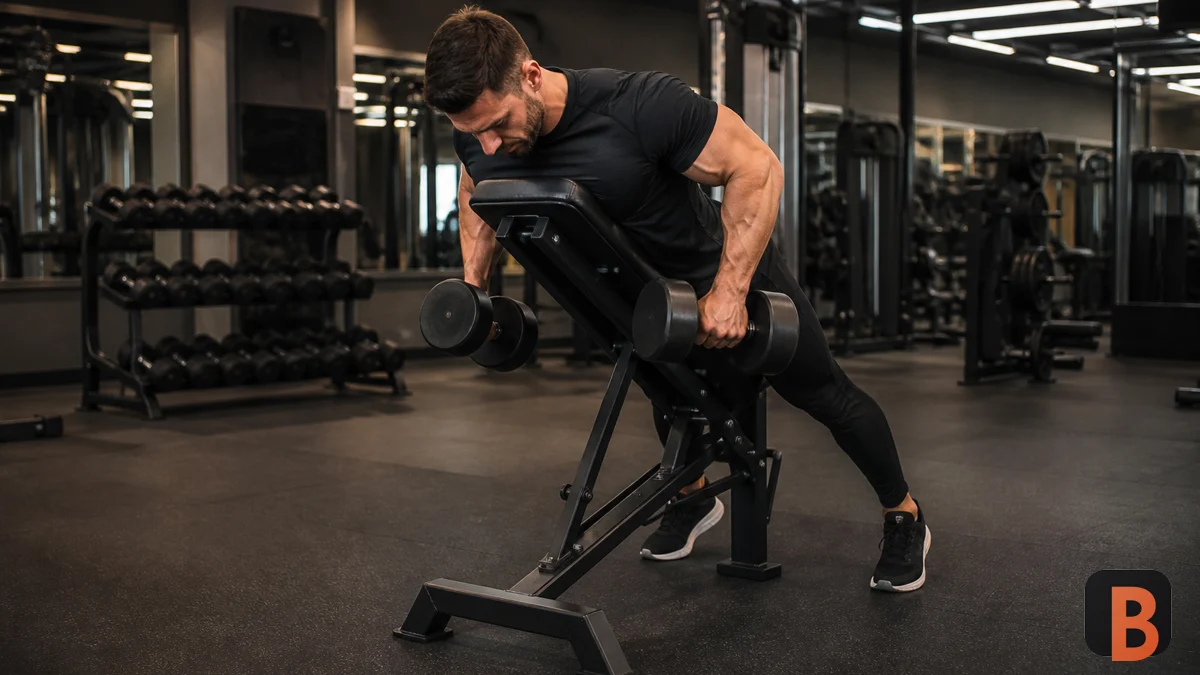
The A/B workout ready for the gym
| Day and order | Exercise | Sets × reps | Effort | Keep this stable |
|---|---|---|---|---|
| A1 | Comfortable-grip lat pulldown or assisted pull-up | 3 × 6–10 | 2 RIR | Grip, assistance and range |
| A2 | Chest-supported row | 3 × 8–12 | 2 RIR | Bench, grip and end pause |
| A3 | Cable pullover | 2 × 12–15 | 2–3 RIR | Pulley height and torso position |
| B1 | Seated cable row | 3 × 6–10 | 2 RIR | Handle, support and range |
| B2 | Single-arm pulldown or pull-up | 3 × 8–12 | 1–2 RIR | Starting side and assistance |
| B3 | Supported high row or reverse fly machine | 2 × 12–20 | 2 RIR | Elbow path and support |
Place days A and B at least two days apart, such as Monday and Thursday. The 16 sets are a starting point distributed across muscles and patterns, not a quota. Begin with two sets per movement if your current volume is low. If you already deadlift, row elsewhere or perform substantial arm work, account for that fatigue before adding anything.
Width and thickness are useful maps, not separate compartments
| Visual shortcut | Organizing pattern | Examples | Boundary to remember |
|---|---|---|---|
| Width | Vertical pulling and shoulder extension | Pull-up, pulldown, pullover | Lats, arms and stabilizers work together |
| Thickness | Horizontal rowing and scapular retraction | Supported row, cable row, high row | Changing elbow path shifts emphasis without turning the rest off |
| Upper back | A more open elbow row and Y raise | Supported high row, reverse fly, Y raise | Local sensation alone does not measure growth |
| Lumbar stability | Hinge or isometric work when the program needs it | Romanian deadlift, extension, unsupported row | It need not be exhausted in every back session |
The included activation studies report small or similar differences between pulldown grips and rowing variations. That is enough to challenge the idea of a magic grip, but not enough to crown a hypertrophy winner: electromyography is a snapshot of activity, not direct long-term muscle growth.
Choose the grip that lets you complete the range, control load and repeat technique without discomfort. Medium or neutral is often a comfortable exit, not an anatomical law. Do not force a painful variation to chase a visual region; change the movement and seek qualified help if pain persists or concerns you.
Progression: improve the reference instead of collecting exercises
- Lock the variation
Keep grip, machine, support and range steady through the block. When any changes, start a new reference instead of copying the old load.
- Add clean repetitions
Work inside the range while holding the planned RIR. Do not count a repetition that clearly shortens range or changes torso position.
- Load after owning the range
When every set reaches the top end on two comparable exposures, try the smallest practical increase.
- Read three exposures
One poor day does not require a new program. Review reps, RIR and technique across at least three comparable references.
| What happened | Next decision | Record | Avoid |
|---|---|---|---|
| Reps rose at the same RIR | Hold load and pursue the top of the range | Load, reps, RIR and variation | Adding an exercise from excitement |
| Top of range twice | Try the smallest jump | Every set outcome | Jumping and losing several reps unnecessarily |
| Reps fell once | Repeat the reference | Sleep, rest and equipment changes | Calling it a plateau |
| Several exposures declined | Remove a set or review load | Three comparable sessions | Changing six variables at once |
Worked example
Your supported row is 70 kg for 10, 9 and 8 reps at 2 RIR. Next week it becomes 11, 10 and 9 at the same effort. You do not need another row; hold 70 kg until all three sets approach the top end. BUSTAFIT can keep that reference apart from a different row.
What the evidence says and does not say
The ACSM position stand and dose reviews support the big picture: resistance training and sufficient weekly volume promote hypertrophy, with diminishing returns as sets accumulate. Frequency is mainly a way to distribute that work; when volume is matched, there is no universal hypertrophy advantage to training a muscle on more days.
Proximity to failure appears related to hypertrophy, although the available meta-regression is exploratory and does not establish one perfect RIR. Most work here therefore sits around 1–3 RIR: hard enough to create a useful reference without requiring failure on every pulldown and row.
None of this turns width and thickness into isolated regions. They are practical labels for distributing vertical pulls, horizontal rows and upper-back work. Final selection still depends on tolerance, equipment and your ability to progress with recognizable technique.
Video summary
Jeremy Ethier demonstrates vertical and horizontal pulls using surface EMG on four people, notes that activation does not equal growth, and promotes a Built With Science plan. Treat it as a visual tour of set-ups, not proof of a universal ranking. BUSTAFIT has no commercial relationship with the channel and bases this routine on the visible evidence and limits above.
Substitutions that preserve the day’s job
| If you lack… | Use… | Preserve | Log as |
|---|---|---|---|
| Pulldown | Assisted pull-up or single-arm pulldown | Vertical pull and tolerable range | New exercise |
| Supported row | Machine or supported cable row | Horizontal row without dominant lumbar fatigue | New exercise |
| Pullover cable | Pullover machine or controlled dumbbell pullover | Shoulder extension with stable technique | New exercise |
| High row | Reverse fly machine or supported open-elbow row | Pain-free upper-back work | New exercise |
A substitution solves today’s gym; it does not prove that two movements are interchangeable kilogram for kilogram. Keep separate histories and compare each exercise with itself. That small habit keeps progression readable two months from now.