
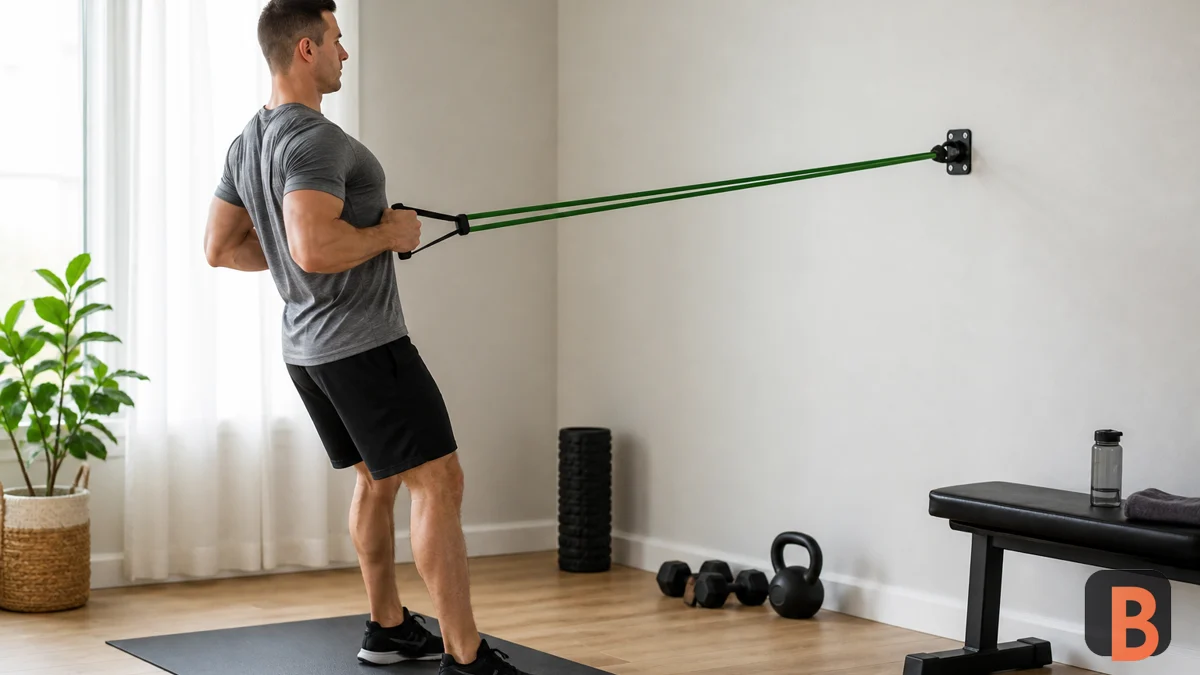
The complete training week
| Day | Exercise | Sets × reps | RIR | Rest | Setup to save |
|---|---|---|---|---|---|
| A | Band squat under the feet | 3 × 10–20 | 2–3 | 2 min | Model, color, stance and grip |
| A | Chest press with rear anchor | 3 × 8–15 | 2 | 2 min | Anchor height and starting distance |
| A | Seated row with band around the feet | 3 × 10–20 | 2 | 90–150 s | Free length and posture |
| A | Band Romanian deadlift | 3 × 10–15 | 2–3 | 2 min | Bottom position, grip and stance |
| A | Single-arm lateral raise | 2 × 12–25 | 1–2 | 60–90 s | Foot anchor and hand distance |
| B | Band static lunge | 3 × 8–15 each side | 2 | 2 min | Front foot, free length and hand position |
| B | Kneeling pulldown from a high anchor | 3 × 10–20 | 2 | 2 min | Height, distance and grip type |
| B | Band overhead press | 3 × 8–15 | 2–3 | 2 min | Band under one or two feet |
| B | Lying leg curl from a low anchor | 3 × 12–20 | 2 | 90–150 s | Height, distance and ankle attachment |
| B | Curl + triceps extension, kept separate | 2 × 10–20 each | 1–2 | 60–90 s | Starting length for each exercise |
| C | Split squat or step squat | 3 × 10–18 each side | 2 | 2 min | Stance and contact point |
| C | Band-resisted push-up | 3 × 8–20 | 2 | 2 min | Band placement across back and hands |
| C | Single-arm anchored row | 3 × 10–20 each side | 2 | 90–150 s | Height, distance and support |
| C | Band pull-through | 3 × 12–20 | 2 | 2 min | Low anchor and starting distance |
| C | Standing band calf raise | 3 × 12–25 | 1–2 | 60–120 s | Support, range and starting tension |
Alternate A, B and C with a free day between sessions when possible. If you only have two days, continue the sequence instead of restarting every Monday: A/B one week and C/A the next. The routine covers movement patterns; it does not assume that a band shares the resistance curve of a machine or free weight.
Progress without kilograms
| Rung | Change | Example | Keep constant |
|---|---|---|---|
| 1. Repetitions | Add reps inside the range | 12, 11, 10 becomes 14, 13, 12 | Band, grip, anchor, position and RIR |
| 2. Sets | Add one set only when the session and week recover | 2 working sets become 3 | The same setup and rep range |
| 3. Starting length | Shorten the free section in a measurable way | Grip one marker closer to the anchor | Band, posture and range |
| 4. Band | Move to another resistance in the same model | Medium to heavy inside one set | Record it as a new reference |
| 5. Variation | Choose a harder or more stable option | Bilateral squat to split squat | Start a separate history |
Do not treat colors as units. In one mechanical evaluation of a CLX product family, measured resistance at equal elongation exceeded manufacturer reference values by 2.3% to 33.1%, depending on color. That result belongs to the tested product and setup, but it shows why “blue band” cannot transfer across brands, models or free lengths as a load.
- Name the variation
Include exercise, brand or model, color and anchor: “green X-band row, feet, seated”.
- Fix the geometry
Mark distance from the anchor or use a floor landmark. Repeat posture, grip and range.
- Log effort
Record reps and RIR. Perception helps compare your own sets, but it does not turn a band into an exact percentage of 1RM.
- Progress one variable
After two exposures at the top of the range and target RIR, add reps, shorten length or change bands—not all three.
Worked example and substitutions
A green-band row that is genuinely comparable
Session 1: the same green band, seated 140 cm from the anchor, grip on the second marker, 14/13/12 reps at 2 RIR. Session 2: 15/14/13. Session 3: 17/16/15. On the fourth, grip one marker shorter and perform 13/12/11 at 2 RIR. That is not regression; it is a tighter variation and a new baseline.
| Problem | Substitution | Keep | New detail to log |
|---|---|---|---|
| No safe high anchor | Lying pullover from a stable low support | Shoulder-extension pull pattern | Support point and starting length |
| The band irritates your back in push-ups | Chest press from a rear anchor | Horizontal press pattern | Anchor height and distance |
| The top of the squat is too easy | Split squat or more controlled tempo | Knee-dominant work | Variation and tempo; new history |
| Grip limits the row | Compatible handle or unilateral row | Range and target muscle | Handle type and side |
| The band is damaged | Retire it; use another band or a band-free exercise | Safety | Do not match color by sight |
The available review supports saying that elastic resistance can improve strength similarly to conventional resistance in the protocols studied. It does not prove that this exact routine matches every gym program for hypertrophy. Control the result you can defend: train useful hard sets, repeat the setup and progress over weeks.
Bring the setup into BUSTAFIT
| Field | What to enter | Why it changes the comparison |
|---|---|---|
| Exercise | Pattern + band + setup | Separates variations that do not share resistance |
| Load | Your model label or a consistent internal unit | Does not invent kilograms or external equivalence |
| Repetitions | Each set separately | Shows set drop-off and progression |
| RIR | Estimated reserve at the end | Separates more reps from an easier set |
| Note | Distance, grip marker or anchor change | Explains a different resistance curve |
BUSTAFIT logs loads, repetitions, effort, volume and history. With bands, “load” can be a consistent label for your setup rather than an imaginary kilogram value. When brand, model, color or geometry changes, create another variation; the history stays truthful even when the number looks less impressive.