
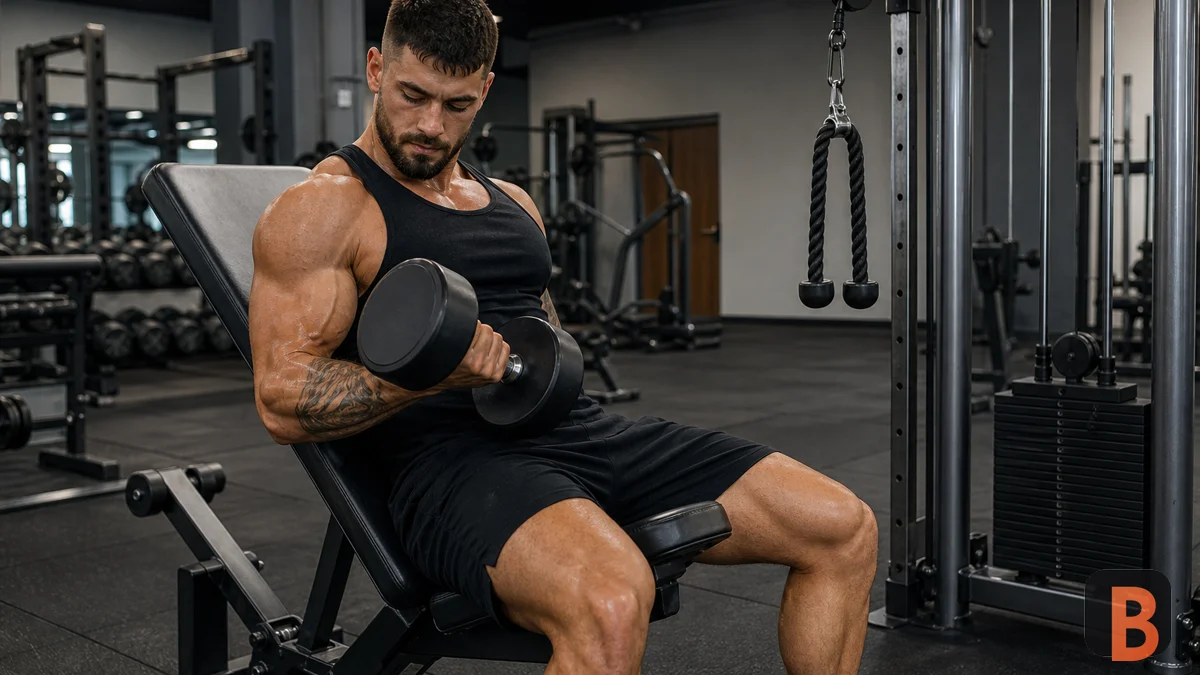
Start with these pairings
| Pair | Type | Best use | Rest after B | Signal to separate it |
|---|---|---|---|---|
| Machine press + chest-supported row | Opposing groups, both stable | Main accessories when time is tight | 90–150 s | The second exercise loses two or more reps at the same RIR |
| Biceps curl + triceps extension | Local antagonist | End of an upper-body or arm session | 60–120 s | Elbow or grip irritation appears |
| Leg extension + leg curl | Machine-based leg antagonist | Accessories after heavy work | 90–150 s | Breathing limits you before the target muscle |
| Lateral raise + calf raise | Minimally related muscles | Use one area without mixing the reference | 60–120 s | The transition costs more time than it saves |
| Pulldown + pullover | Same group or overlapping pattern | Occasional moderate-load finisher | 120–180 s | Volume or technique collapses |
| Squat + Romanian deadlift | High systemic demand and overlap | Not our default pairing | Keep separate | Any loss of control, brace or performance |
The rest column is a practical starting point, not a universal stopwatch. Across a heterogeneous set of studies, the review suggests a small benefit over very short pauses and found no appreciable differences beyond roughly 90 seconds. Demanding compounds may need longer. When heart rate and technique, rather than the target muscle, dictate the next set, you are not ready yet.
What supersets save and what they do not automatically improve
| Outcome | What the review reports | Practical use | Boundary |
|---|---|---|---|
| Duration | Shorter sessions and greater time efficiency | Use them when time is the real barrier | A slow transition can erase the benefit |
| Repetitions and volume | Similar overall, with variation by pairing type | Prefer antagonists or low-overlap groups | Biomechanically similar pairings can reduce volume load |
| Perceived effort | Often higher | Keep some reserve and do not chase sensation alone | More fatigue does not equal more growth |
| Chronic strength and hypertrophy | Similar adaptations in pooled studies | Treat supersets as an efficient alternative | This does not support superior hypertrophy |
| Recovery | Internal load can rise | Watch the following session’s performance | A dense week may require another variable to fall |
The 2025 systematic review is reassuring and deliberately unglamorous: supersets can compress a workout without automatically sacrificing volume or chronic adaptations, but they usually feel harder. That is exactly why they should solve a scheduling problem rather than become a suffering contest.
The saving does not come from deleting all rest. It comes from filling part of exercise A’s pause with a compatible exercise B, then resting after the pair. If you run A to B and immediately return to A, you have built a more demanding circuit, not necessarily a better hypertrophy superset.
A four-week protocol that keeps history clean
- Week 1: establish the reference
Perform the priority exercise with traditional sets. Record load, repetitions, RIR and actual rest.
- Week 2: add one pair
Combine two stable accessories and leave everything else untouched. Use a short transition and rest after exercise B.
- Week 3: compare performance
Check each exercise against its own reference. If the second repeatedly loses two or more reps at the same RIR, rest longer or split them.
- Week 4: decide
Keep the pairing if it saves time while technique, volume and recovery hold. Return to traditional sets if it only adds fatigue.
| Field | Exercise A | Exercise B | Why it matters |
|---|---|---|---|
| Variation | Exact name | Exact name | Prevents mixed histories |
| Load and reps | Every set separately | Every set separately | Pair totals do not describe progression |
| RIR | At the end of A | At the end of B | Separates local fatigue from rushing |
| Transition | A → B | Approximate seconds | Makes comparison reproducible |
| Rest | After B | Until the next A | Explains some gains or losses |
Worked example
With traditional sets you machine press 60 kg × 10 and chest-supported row 70 kg × 11, both at 2 RIR. In the superset the press holds, but the row falls to 8 reps at 1 RIR for three rounds. You have not discovered useful extra intensity; the pairing is stealing performance. Rest longer or choose a less demanding row.
Where supersets belong in a hypertrophy workout
| Block | Format | Example | Job |
|---|---|---|---|
| 1 | Traditional sets | Main press or squat | Preserve a clean load reference |
| 2 | Low-overlap superset | Supported row + lateral raise | Save time without competing for one pattern |
| 3 | Antagonist superset | Curl + triceps extension | Complete accessories with short transitions |
| 4 | Optional | Calf + trunk work | Use remaining minutes without extending the session |
You do not need to convert the whole routine. One or two well-chosen pairs capture much of the saving. Keeping the first lift separate makes warm-up, technical control and load comparison easier. Stable machines and supports then make accessory transitions less chaotic.
In a busy gym, avoid occupying two distant stations. A theoretically perfect pair that sends you across the room, loses equipment or inconveniences someone else is not efficient. Replace exercise B with something nearby or return to traditional sets.
Video and limits: sensation is not the outcome
Short rests can raise the pump and perceived effort, but an intense sensation does not prove superior adaptation. For hypertrophy, keep hard repeatable sets, recoverable volume and progression that remains visible over several weeks.
Video summary
This 75-second clip offers a fast visual prompt and its description provides no supporting method beyond saying that pairings differ. Treat it as an exercise example, not evidence or a complete program. The content belongs to musclemonsters, BUSTAFIT did not commission it, and this guide relies on the visible scientific reviews for its claims.